A Roman blind is a fabric window treatment that rises into horizontal folds. That simple description is accurate, but it does not explain why two Romans of the same size can look and operate very differently. The result depends on a chain of decisions: the cloth, lining, fold construction, headrail, mounting position, finished weight, lifting arrangement, fixing substrate and the conditions at the window.
This guide explains those decisions as one system. It is not a list of universal rules. Fabrics and hardware have their own specifications, and the final proposal should be checked against the actual opening and the products being supplied.

Begin with the window, not the style name
Before choosing between a classic, relaxed or waterfall Roman, inspect the opening. Record the reveal depth, architraves, sill, window handles, locks, flyscreens, opening direction and any projecting hardware. Look above the window as well as within it. The space available for the headrail and raised stack can affect how much glass remains visible when the blind is open.
Furniture matters. A desk, banquette, bedhead, sofa or cabinet may make a Roman particularly useful because the treatment operates vertically and does not need curtain stack-back at the side. The same furniture can complicate access to a manual control or restrict how an installer reaches the proposed fixing points.
The substrate behind the visible surface also matters. A headrail carries the complete blind, not merely the face fabric. A technically plausible position may still be unsuitable if it does not provide reliable fixing or future access for adjustment and servicing.
Fabric suitability is a performance question
Roman blinds put the fabric on full view when lowered and repeatedly bend it as the blind rises. A cloth selected only for colour can disappoint if its weave, weight or finish is unsuitable for that movement.
Consider:
- Weight and thickness. A substantial cloth can give presence, but it also increases finished load and stack bulk.
- Weave stability. A loose or mobile weave may stretch, skew or settle unevenly.
- Drape. A very fluid cloth can soften fold definition; a rigid cloth can resist folding and build a bulky stack.
- Usable width. A blind wider than the usable cloth may require joins.
- Pattern repeat. Stripes, checks and large motifs expose small alignment errors.
- Surface and finish. Embroidery, pile, slub, coatings and applied details can change how the fabric folds or how marks appear.
- Direction of use. A fabric should not be railroaded merely to avoid seams unless its supplier permits that orientation and the resulting behaviour is suitable.
- Exposure. Strong sun and UV can affect colour and fibres. Orientation and glazing should be discussed rather than assuming every decorative textile will perform alike.
The word linen describes fibre content or appearance; it does not certify Roman-blind suitability. Warwick publicly cautions that predominantly cotton or linen fabrics may develop faded striping in Roman applications and recommends correct product specification.1 That does not mean every linen look must be rejected. It means the exact fabric, exposure, lining and supplier guidance need to be checked. A linen-look blend that is approved for the use may be more suitable than a pure linen chosen only for its name.
Lining changes more than light transmission
Lining sits behind the face fabric, but its effect is visible from the room. It can add privacy, body and stability; reduce transmitted light; support the presentation of a lightweight face cloth; and change the weight, thickness and way the folds settle.
A light-filtering or standard lining may preserve a softer daytime effect. A dimout or blackout lining can provide stronger control through the textile. James Dunlop Textiles notes that its blackout lining adds body and provides a stable base for Roman blinds.2 That is useful product guidance, not a promise that every lining behaves identically.
The distinction between blackout material and a blackout room is important. Blackout lining can prevent light passing through the textile itself. An operable Roman still has edges, a headrail and a relationship with the reveal or wall. Light can enter around the perimeter. A face fit with deliberate overlap may provide more coverage than a recess fit, but the full installed condition determines the result.
Interlining can add body and a fuller textile quality in an appropriate decorative treatment. It also adds weight and bulk. On a compact opening or already substantial fabric, that extra layer can work against a neat raised stack. It should be specified for a reason, not treated as an automatic upgrade.
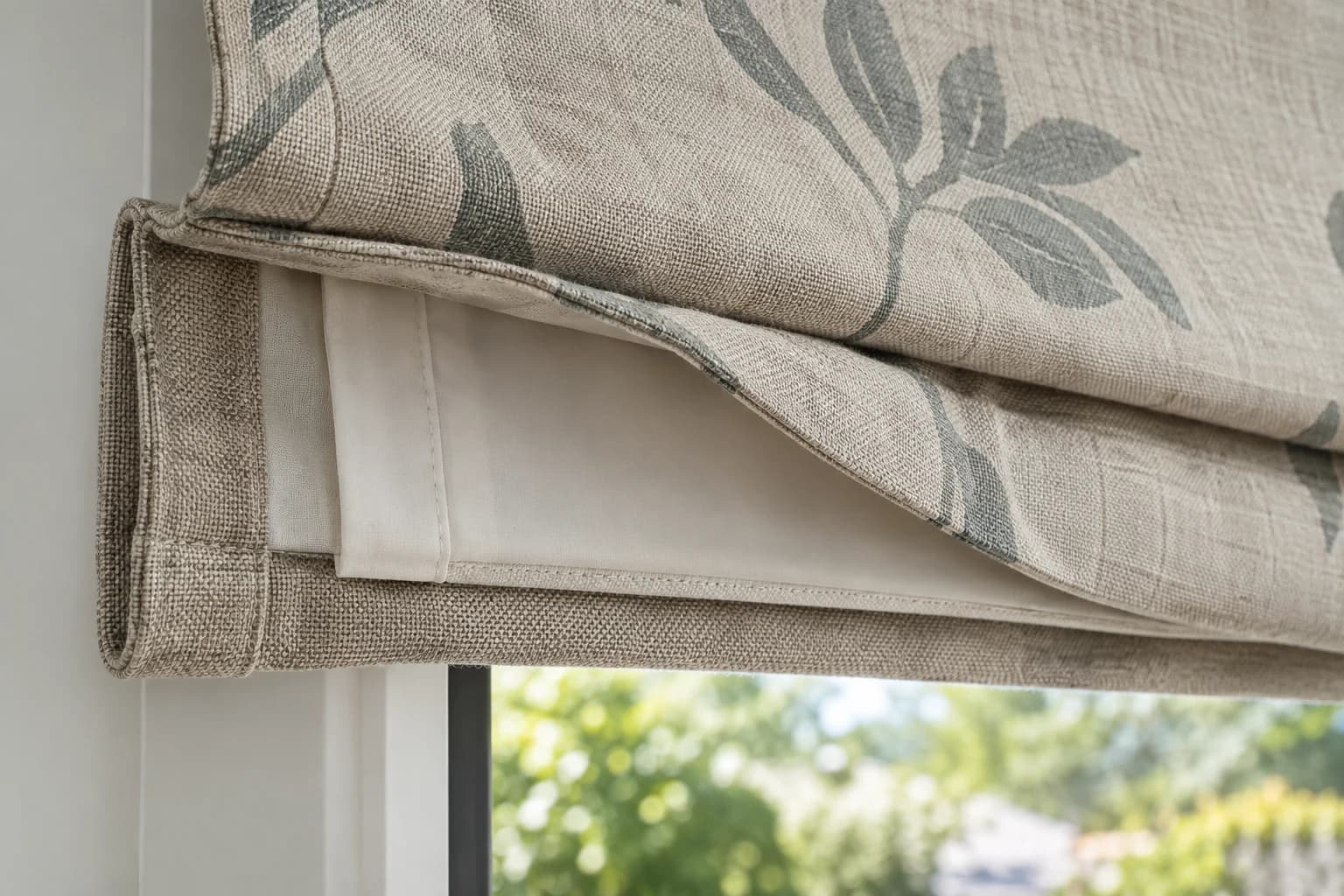
Pattern placement begins before cutting
A Roman is unforgiving of casual pattern placement because it presents a contained rectangle of cloth. When lowered, the centre line, top cut and side balance are visible. When raised, the folds interrupt and repeat the motif.
For stripes and checks, decide whether the pattern can remain square across the finished width and how it will relate to adjacent Romans. For a large floral or geometric repeat, establish which part of the design should occupy the centre and what will be lost at the top, bottom and turned edges. When multiple blinds share one room, they may need a common visual datum even if the windows differ slightly.
Wide blinds can require seams. A join that disappears in a textured plain may become conspicuous in a backlit, lightly coloured fabric. Seam positions and pattern matching should therefore be part of the approved cutting plan, not an unexpected workroom consequence.
Fold construction and the raised stack
Customers often judge a Roman while it is down. A maker also thinks about what happens as it goes up.
A classic Roman generally reads flatter when lowered and forms horizontal folds as it rises. A relaxed Roman has a softer lower profile and depends more visibly on the drape and stability of the fabric. A waterfall Roman retains cascading folds across the face, giving depth but also using more fabric and creating a more substantial stack. These are useful descriptions, not universal construction standards; workrooms and hardware systems can resolve them differently.
Fold spacing influences the rhythm of the blind. The fabric, lining, battens or supports, lift points and bottom finish need to work together so the face rises in a controlled way. Thick cloth, interlining, a deep waterfall and a tall drop can all increase stack depth.
The raised stack matters because it occupies space. In a recess it can cover upper glazing. Mounted higher on the face, it may clear more glass, but the blind then needs appropriate overlap, proportion and fixing. A Roman intended to sit below a cornice or within joinery must leave enough room for the actual folded assembly, not just the bare headrail.
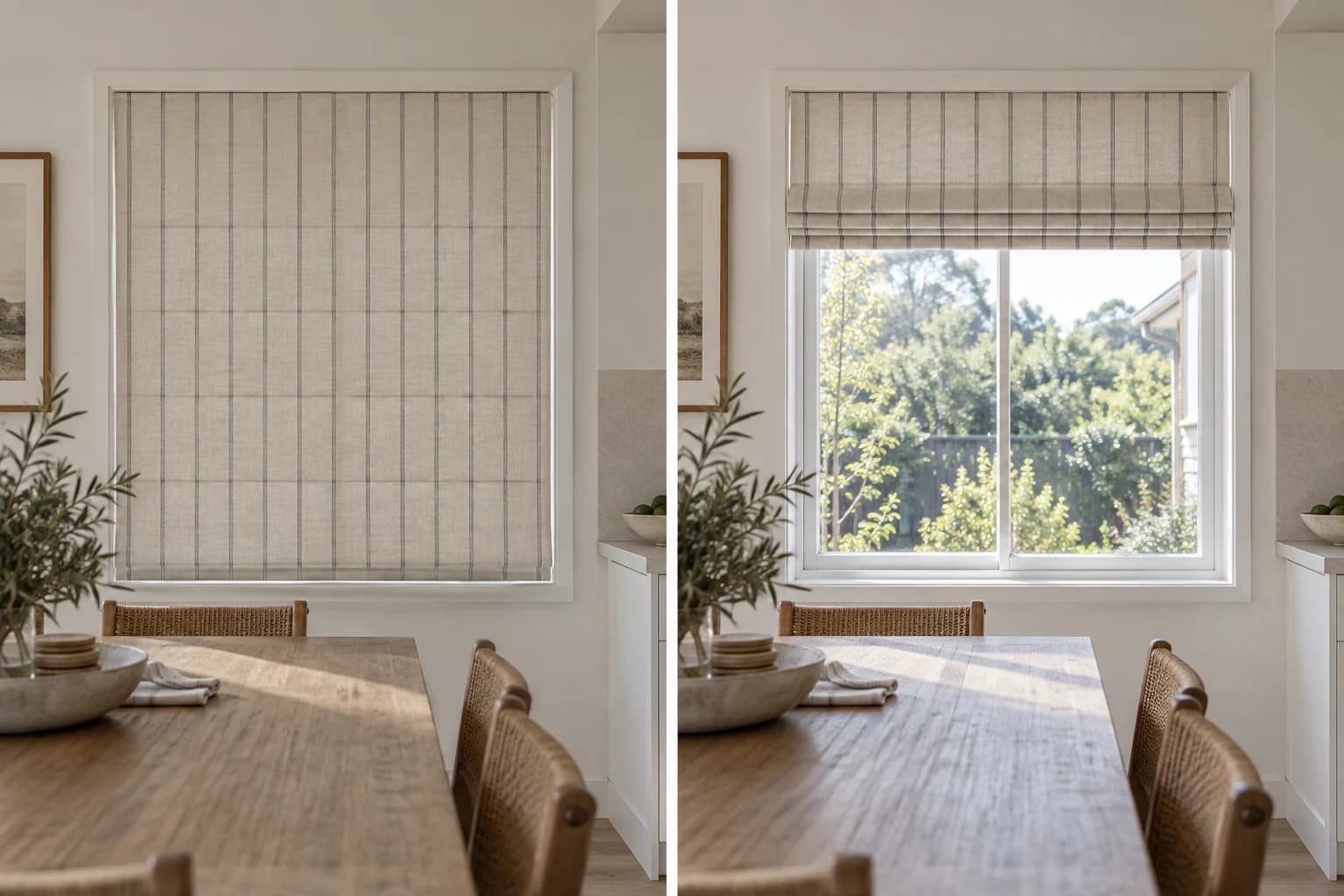
Inside mount or outside mount
An inside-mounted Roman sits within the reveal. It can feel contained and architectural where the reveal is square, deep enough for the system and free of obstructions. The architraves remain visible, but the blind usually has narrow operating clearances at the sides. Those clearances are relevant to privacy and room darkening.
An outside-mounted Roman sits on the wall or over the architrave. Additional width and height can increase coverage and may position the raised stack above more of the glazing. The overlap should be designed for that window: too little may not achieve the intended coverage, while too much can look heavy or conflict with nearby walls, cornices and joinery.
Neither method is inherently more refined. The correct position is the one that resolves operation, light, proportion, fixing and the architecture together.
Light control and privacy
Roman blinds are available in textile assemblies that range from softly filtering to opaque. The right choice depends on when the room is used and what sits beyond the glass.
In a living or dining room, filtered daylight may be desirable and evening privacy may be the stronger requirement. In a bedroom, transmitted light and perimeter gaps may matter early in the morning. A street-facing study might need screen-level privacy without making the room feel closed all day. The answer could be a Roman, a layered treatment or another product.
Do not assess privacy from a sample held against an internal wall. View the proposed face fabric and lining against daylight, then consider the night-time condition when the room is lit from within. Light colour, weave and lining can change the apparent result.
Width, drop and when one Roman becomes too much
As width and drop increase, so do textile area, finished weight, lifting demand and the load transferred through the headrail and brackets. Fabric width and pattern repeat can introduce joins. A wide blind may also be more sensitive to small variations in lift and settling.
There is no responsible universal maximum for “a Roman blind”. Capacity depends on the selected hardware, fabric assembly, control, dimensions and fixing. An experienced supplier may recommend multiple aligned Romans, a different fabric, a different mounting position, motorisation, a roller blind or curtains.
Being able to make a Roman does not always mean a Roman is the right treatment for that opening. Large sliding doors, heavily used access points or very broad glazing may be better served by a treatment that stacks elsewhere or carries the load differently.
Manual operation, motorisation and safety
Manual Roman systems can use a cord or chain depending on the selected hardware. In Australia, corded internal window coverings are subject to mandatory requirements covering supply, labelling, safety components and installation. The ACCC states that there are two mandatory standards and provides current installation requirements for securing loose cords.3 The exact supplied system and installation must comply; legal dimensions should not be reconstructed from memory or reduced to a casual sales claim.
Motorisation can be useful for higher windows, larger blinds, multiple aligned Romans or rooms where regular operation should be simple. It must be designed into the treatment. Finished weight, dimensions, headrail, lift arrangement, motor capacity, power, controls, fixing and future service access need to be considered before manufacture.
Somfy Australia identifies Roman blinds as a carrier application and explains that carrier type, blind weight and headrail size affect motor torque, diameter and speed selection.4 That supports the decision process, but it does not establish which Somfy system CCBD supplies for a particular job. Manufacturer, motor, control protocol and capacity should remain project-specific until confirmed.
Battery power may suit some existing-home applications; wired power may be preferable for selected new-build, concealed or frequently operated systems. Availability and suitability depend on the actual product. Smart-home integration should only be promised after confirming the motor, control platform and scope of works.
Cleaning and long-term care
A Roman blind is not automatically washable because it is made from fabric. Cleaning depends on the face fabric, fibre content, dye or finish, lining, trims and construction. Removing a blind can disturb cords, battens, alignment and safety components, so customers should not be given universal dismantling instructions.
Routine care normally begins conservatively: manage dust without crushing or pulling the folds, and follow the current care specification for the exact fabric and lining. Do not assume that steam, spot chemicals or a domestic washing machine are suitable. James Dunlop recommends specialist professional cleaning for its coated thermal and blackout linings, while individual product sheets show that care instructions can differ between lining products.2 The product-specific instruction takes precedence over a generic article.
Sunlight is also part of care. No interior textile should be described as immune to fading. Glazing, orientation, exposure, colour, fibre and the time a blind remains lowered can all influence ageing. Where strong west-facing or coastal light is relevant, discuss the exposure when selecting the textile rather than after a visible change appears.
Where Roman blinds commonly go wrong
Unsuitable fabric
The cloth may distort, become bulky, settle poorly or prove unsuitable for the exposure. Risk reduction: check the supplier’s intended use, usable width, stability, care and lightfastness data, then assess the complete lined sample.
Incorrect lining
The blind may have the wrong body, transmitted-light result or stack bulk. Risk reduction: select lining with the face fabric, room brief and construction—not as a late substitution.
Poor pattern placement
Stripes, checks and large repeats can reveal an off-centre cut or poorly planned joins. Risk reduction: approve centre line, repeat placement and seam positions before manufacture.
Inaccurate measurement
The blind can conflict with handles, opening sashes or surrounding joinery, or provide inadequate coverage. Risk reduction: measure the actual opening, note obstructions and confirm the proposed finished position.
Ignoring the raised stack
More glazing may be covered than the customer expected. Risk reduction: estimate the complete stack for the chosen fabric and construction, then review mounting height against the elevation.
Oversizing the treatment
Finished weight, operating effort or fold control can become compromised. Risk reduction: verify system limits and consider multiple treatments or a different product before ordering.
Inadequate fixing
The headrail is only as reliable as what supports it. Risk reduction: identify the substrate and bracket positions, and include suitable installation planning.
Motorisation specified too late
The blind, power and motor may not work together optimally. Risk reduction: resolve motor, headrail, finished weight, controls, access and power before workroom production.
Incorrect cleaning
Fabric, coating, dimensions or fold alignment can be damaged. Risk reduction: retain the approved fabric and lining care information and use a specialist when required.
The useful question is not “Which Roman do I like?”
It is: Which fabric construction, position and operating system will give this window the appearance and performance we want? A good answer includes the room, the view when the blind is raised, the light at the edges, the weight carried by the hardware and the way the textile will be cared for later.
That is why a custom Roman should be specified as a complete moving treatment rather than a decorative fabric panel with a mechanism added afterwards.
Continue exploring
- Roman Blinds
- Why Roman Blinds?
- Linen Roman Blinds
- Motorised Roman Blinds
- Roman Fabric & Lining
- Roman Proportion & Fitting
- Free Design Consultation
Sources
- Warwick Fabrics Australia, Helpful Tips, Roman-blind caution for predominantly cotton or linen constructions.
- James Dunlop Textiles, How to choose the right lining, including Roman stability and product-dependent care guidance.
- ACCC Product Safety, Blinds, curtains and window fittings mandatory standard.
- Somfy Australia, Motor selection is easier than you think.