A Roman blind looks simple because most of its construction disappears when the job is finished. That simplicity is exactly why mistakes are easy to see.
The design work begins before fabric reaches the cutting table. The maker needs a reliable description of the window, an approved textile assembly and a decision about how the blind should look both lowered and raised. The following is the practical sequence behind that result.
1. Decide whether the fabric can do the job
Do not begin with the assumption that any curtain fabric can become a Roman. A curtain hangs vertically; a Roman repeatedly bends across horizontal lift positions. The cloth must present well across a relatively flat face, turn cleanly at the edges and form a controlled stack without becoming excessively bulky.
Check the supplier specification and a generous sample. Weight, weave stability, stretch, thickness, surface texture and finishing all matter. Confirm usable width and whether joins will be needed. If railroading is proposed, verify that the supplier permits the fabric to be used in that direction and that the weave and pattern will behave appropriately.
Natural fibre content needs particular care. Warwick advises against assuming predominantly cotton or linen fabrics are suitable for Roman blinds because faded striping can occur, and it asks specifiers to select the correct product for the application.1 The desired linen character can sometimes be achieved with an approved linen blend or linen-look cloth. The label alone is not the specification.
Also record exposure. A strongly sunlit window, especially where the blind remains in one position for long periods, places a different demand on colour and fibre from a protected opening. Supplier lightfastness and intended-use information should inform the decision; no interior cloth should be promised as fade-proof.
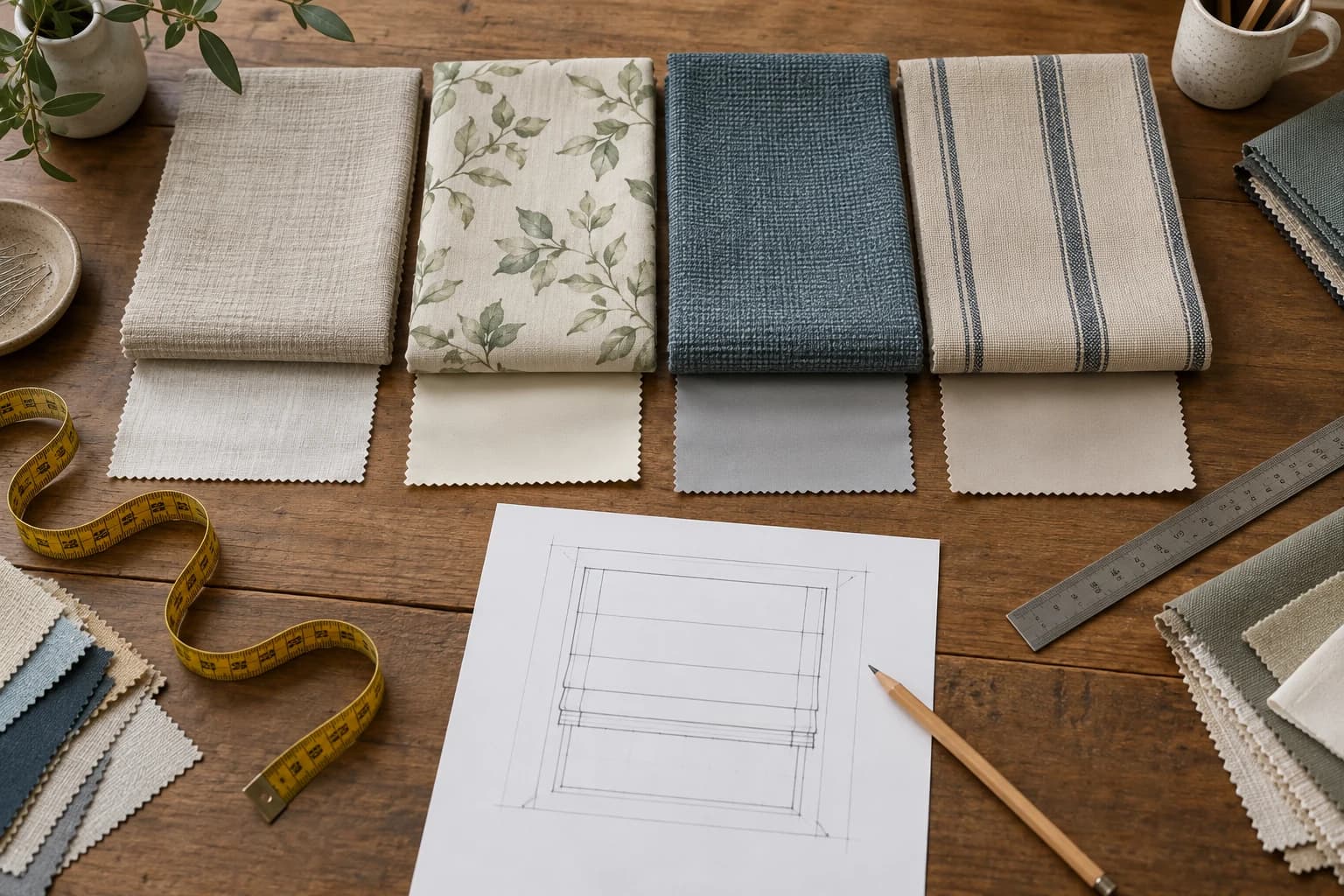
2. Record the whole window condition
A width and drop are not enough. At measure, inspect:
- reveal depth and whether it changes across the opening;
- architraves, sill and the wall above;
- handles, locks, flyscreens and opening direction;
- cabinetry, desks, banquettes, beds and other access constraints;
- the likely fixing substrate and bracket positions;
- nearby windows whose top lines should align;
- the required coverage and finished position.
These observations decide whether an inside mount is feasible and whether it gives the intended light control. They also show whether an outside mount can clear more glass when raised, cover the opening more generously or establish a better relationship with neighbouring windows.
This is why a complex Roman should not be reduced to a DIY measuring instruction. The manufacturing dimensions are only one output. The measure should also define the visual and operational position of the treatment.
3. Draw the proportion before cutting
A technically accurate rectangle can still look wrong. Consider how the finished width and drop relate to the window, wall, ceiling and furniture. A tall, narrow Roman may emphasise height; a short, broad one can look heavy if its fold scale is not controlled. Several Romans in one room need a consistent datum even where the reveals differ.
Pattern adds another layer. Establish the centre line, top cut, visible side balance and likely fold positions. Stripes and checks reveal skew quickly. A large repeat may require additional fabric so the important motif can be centred. On wider treatments, plan joins where they are least disruptive and explain that backlighting can make a seam more visible.
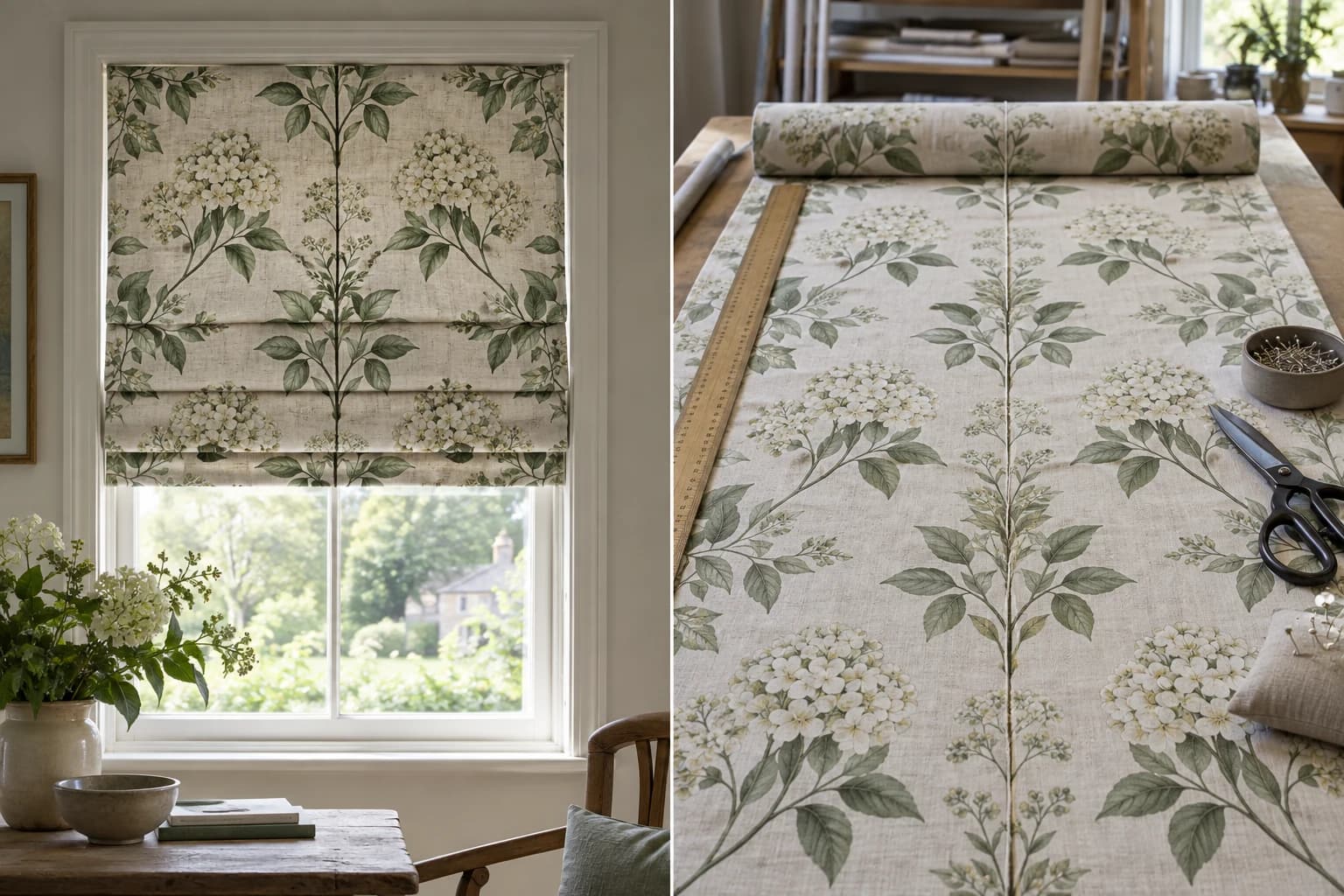
4. Specify face fabric and lining as one assembly
Lining can alter privacy, light transmission, body, stability, face-fabric presentation and finished weight. James Dunlop Textiles notes that its blackout lining adds body and creates a stable base for Roman blinds.2 That guidance applies to the described product; the care and behaviour of another lining must be checked separately.
Blackout lining blocks transmission through the textile. It does not seal the perimeter of an operable blind. If strong room darkening is required, review side clearances, headrail position, sill and mounting overlap. Avoid turning a lining property into a promise of complete darkness.
Interlining can add body but also stack depth. Use it where the decorative and construction brief supports it, not by default.
5. Design the blind raised as well as lowered
The fold spacing, support method, lining and fabric thickness determine how the blind collects. A customer sees a calm fabric face when the blind is down; the maker must also anticipate the bulk, rhythm and stability of the raised stack.
Estimate where that stack will sit relative to the glazing and architrave. If mounted inside the reveal, it may cover upper glass. If mounted above the opening, the face-fit width, height, overlap and fixing need to remain visually convincing.
For a very wide or tall Roman, calculate rather than guess. Increasing dimensions increase textile area, finished weight, headrail demand and operating effort. One large blind may need to become two aligned Romans; a different cloth, mounting method, motorised system, roller or curtain may be more reliable. Being able to manufacture the shape does not prove it is the right treatment.
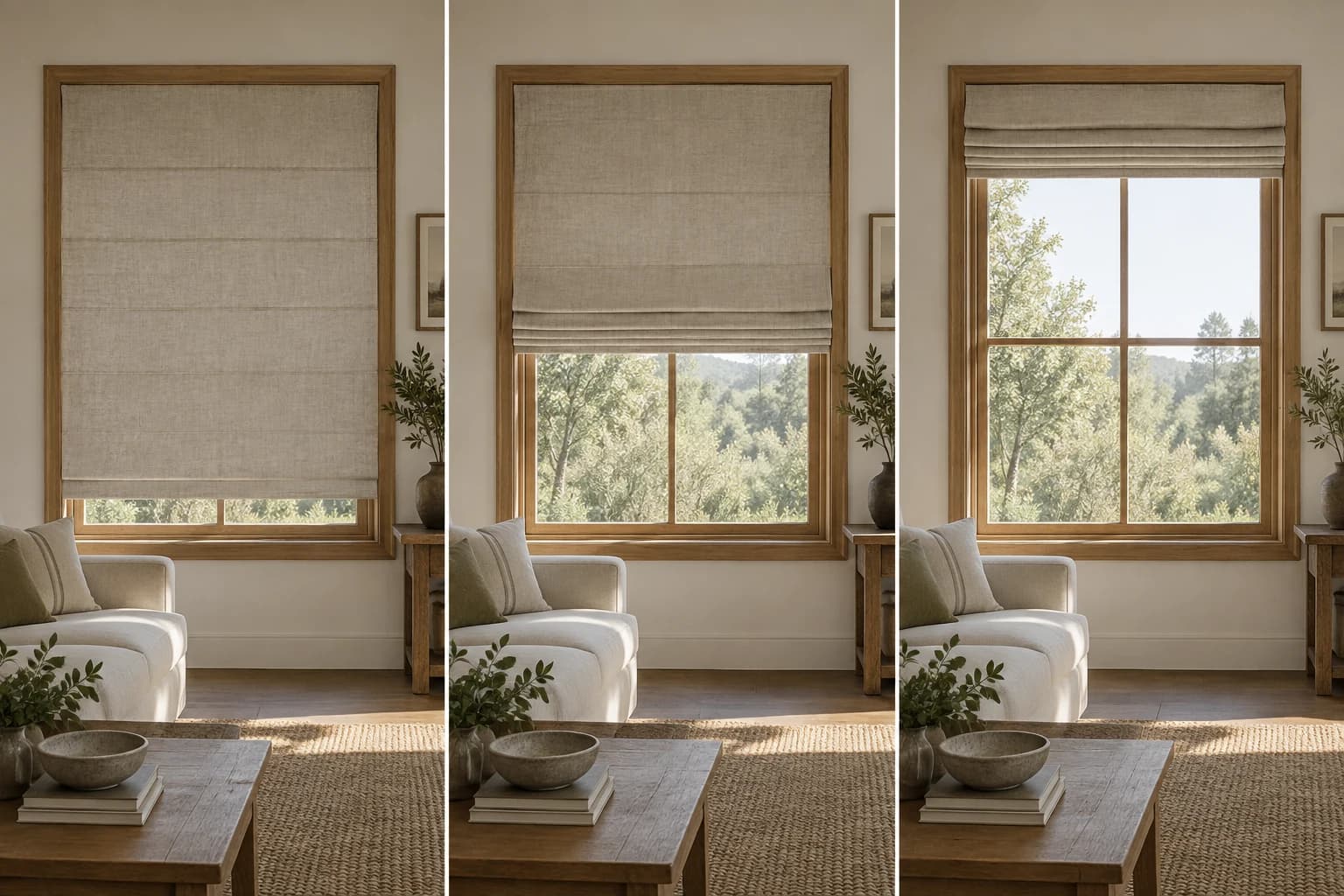
6. Match the headrail and control to the finished blind
The headrail carries the complete textile assembly. Manual operation needs an appropriate control and an installation that meets current Australian cord-safety requirements. ACCC Product Safety identifies separate mandatory standards for supply and installation of corded internal window coverings, including warning, component and securing requirements.3 The selected system must be installed to the applicable standard rather than described with remembered shorthand.
For motorisation, confirm dimensions, finished weight, lift arrangement, motor capacity, headrail, power, controls and service access together. Somfy Australia states that Roman blind carrier type, blind weight and headrail size affect motor selection.4 Do not promise a motor, battery runtime or integration until the actual CCBD-supplied system is known.
7. Make installation part of the design
Before production, establish bracket locations and the support behind them. Check access around cornices, pelmets, cabinetry and adjacent treatments. Concealed work in a renovation should leave the required power position, headrail space and a realistic path for future servicing.
At installation, alignment and travel need to be checked at the actual window. Multiple blinds should share intended visual lines. Controls and safety components should be fitted correctly, and the customer should receive operation and care guidance for the supplied fabric and hardware.
The aim is not an abstractly perfect Roman. It is a blind whose cloth, folds, stack, headrail and window conditions have been made to agree.
Continue exploring
- Roman Blinds
- Motorised Roman Blinds
- Roman Fabric & Lining
- Roman Proportion & Fitting
- Free Design Consultation
Sources
- Warwick Fabrics Australia, Helpful Tips.
- James Dunlop Textiles, How to choose the right lining.
- ACCC Product Safety, Blinds, curtains and window fittings mandatory standard.
- Somfy Australia, Motor selection is easier than you think.