A Roman blind occupies an interesting position between textile furnishing and architectural window treatment. It introduces cloth, colour and pattern, but it stays closely related to the opening rather than extending across the wall and down to the floor.
That contained presence explains many of its strongest applications. A Roman can soften one window without asking the room to accommodate curtain stack-back. It can sit above furniture, give a patterned fabric a defined field and connect with cushions or curtains elsewhere. Its success still depends on proportion: a beautiful cloth does not compensate for a stack that blocks too much glass or a blind that feels too small for the elevation.
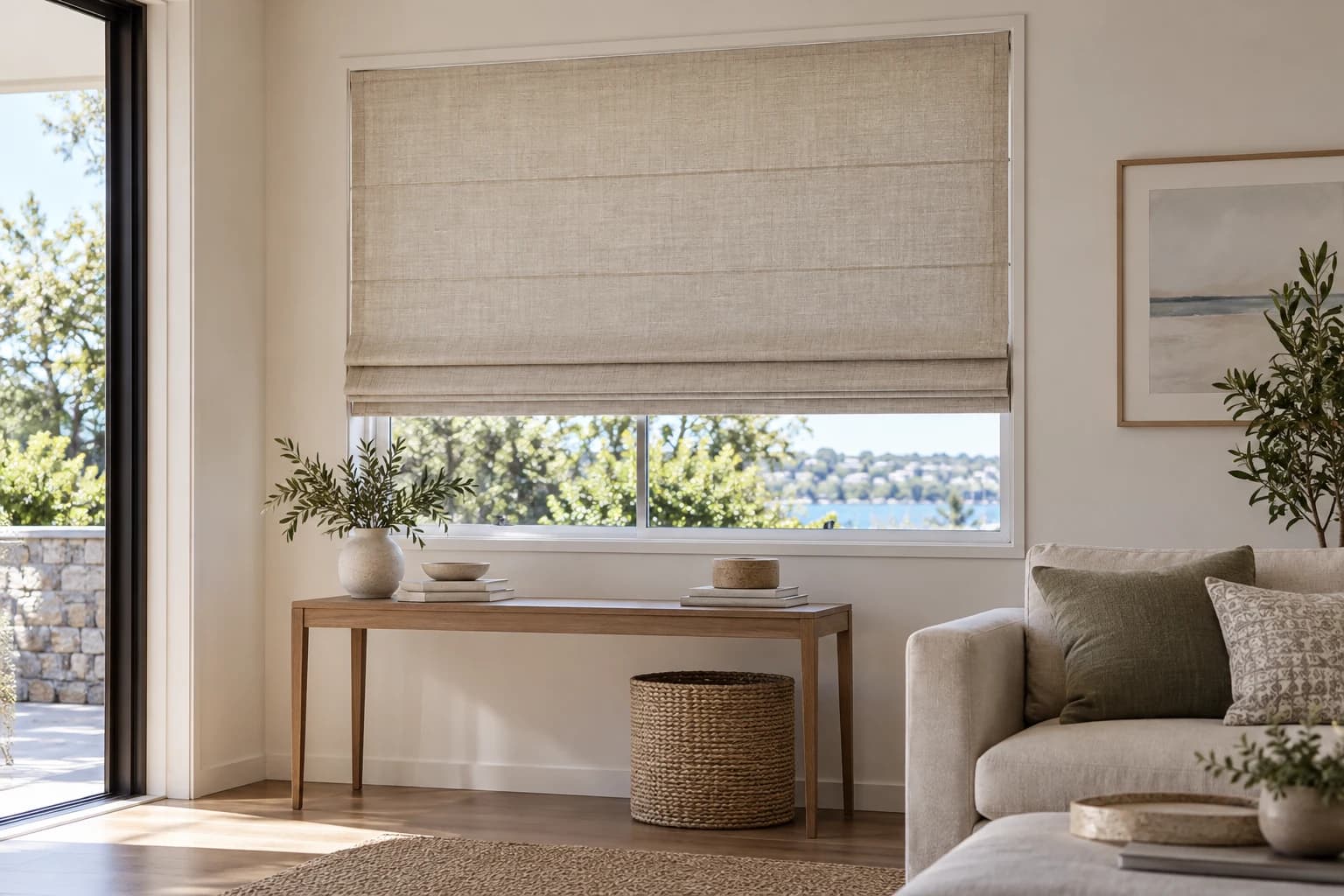
Bedrooms: fabric without full-length volume
In a bedroom, a Roman can provide softness where full curtains would compete with a bedhead, bedside table or narrow return wall. A patterned face can act almost like a framed textile when lowered; a restrained plain can keep the room quiet while still feeling more furnished than a compact roller.
Light control must be discussed as an installed condition. A blackout lining can prevent light passing through the cloth, but edge clearances remain. Where early-morning darkness is important, an outside mount with considered overlap or a layered treatment may be more appropriate than a neat recess fit. The operating control also needs to be placed safely and within practical reach without conflict with the bed.
The fabric choice should suit both the atmosphere and the movement of the blind. A heavy cloth may be visually comforting but produce more stack. A delicate, loose weave may look attractive on a sample and settle less reliably in a moving construction.
Living rooms: judge the window within the elevation
Romans can work well on contained windows where the treatment should have presence without visually widening the opening. They are especially useful when artwork, joinery, a fireplace or furniture already gives the wall a strong composition.
On broad glazing or frequently used doors, curtains or another blind type may perform better. The question is not whether a Roman can physically be made, but whether its width, weight, raised stack and daily operation suit the opening. Multiple Romans can align across a bank of windows, but the divisions should relate to mullions and the architecture rather than being chosen only to meet a hardware limit.
In a living room with different window types, continuity can come from colour and material instead of identical products. A Roman on a smaller side window might share an oatmeal tone with full-height sheers across sliding doors. The treatments feel related without pretending the two openings have the same needs.
Studies and home offices: contained treatment, clear working space
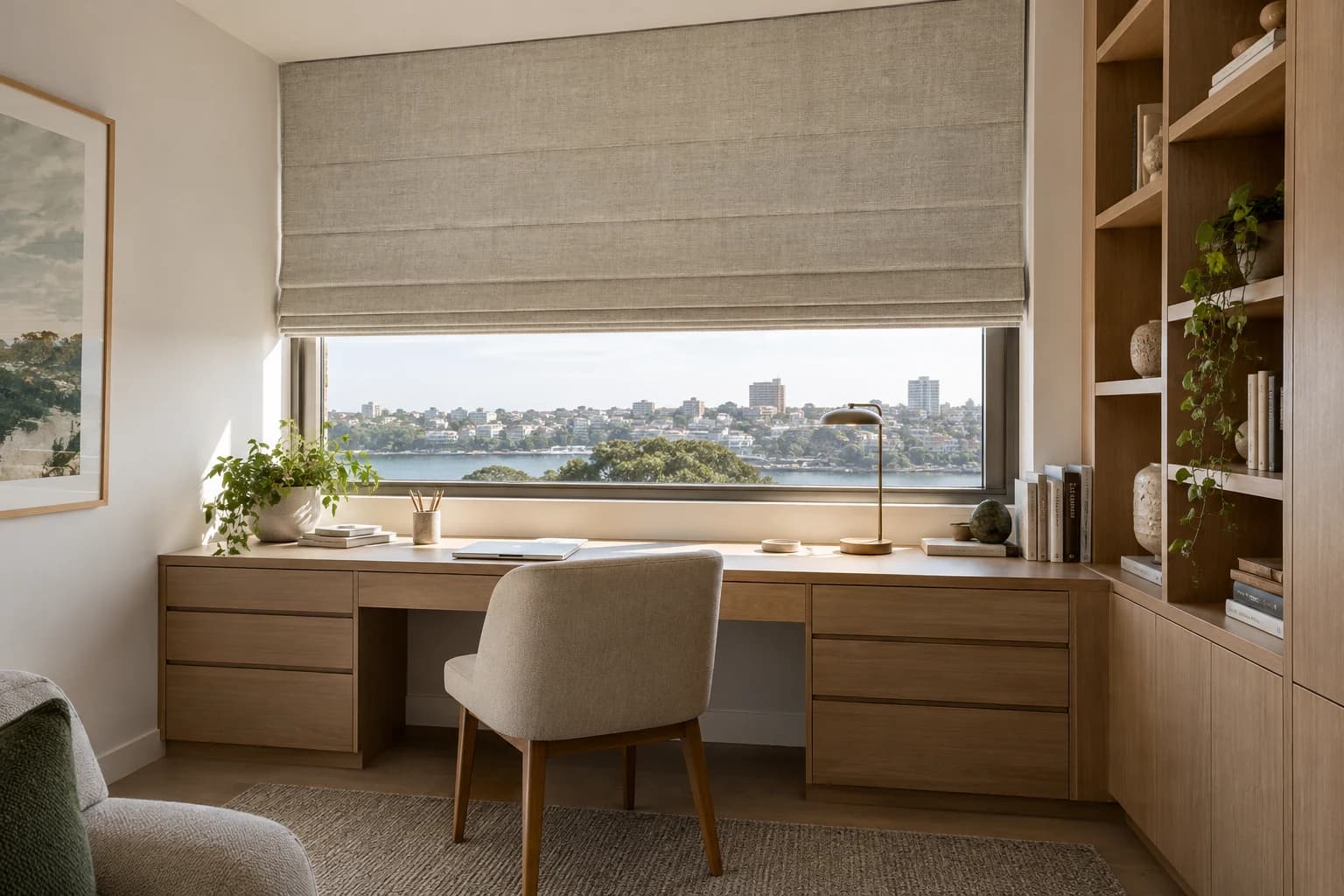
A window above a desk is one of the Roman blind’s most convincing positions. The vertical movement keeps fabric away from the work surface and does not require curtain stack-back beside shelving or cabinetry. The blind can reduce visual brightness at the glass while introducing texture into a practical room.
The fit still needs to respect monitor glare, privacy and window operation. If the desk makes a manual control awkward to reach, motorisation may be worth considering. Power and service access should be resolved rather than concealed behind finished joinery as an afterthought.
Dining rooms: a place for pattern
A dining room often offers more freedom for colour, stripe, check or botanical pattern than a bedroom requiring visual calm. Because the Roman uses a limited area of cloth, it can introduce a confident furnishing fabric without covering an entire wall.
Pattern scale should be judged at the finished size. A small sample does not show how a large repeat will be centred or interrupted by folds. Where the blind sits behind a banquette or sideboard, the lowered composition should relate to the furniture rather than appearing as a disconnected panel.
Windows above furniture
Roman blinds are particularly useful above a bed, desk, banquette, console or sofa. In each case, they allow furniture to occupy the wall below or beside the opening without colliding with curtain drops.
This is not permission to ignore access. The blind needs to clear projecting furniture, and the installer needs a reliable route to the headrail. A chain hidden behind a deep sofa is not convenient; a motor should not be specified without confirming load, power and control. The position of the raised stack also matters if the furniture encourages the eye to focus directly on the window.
Traditional and Federation-influenced Sydney rooms
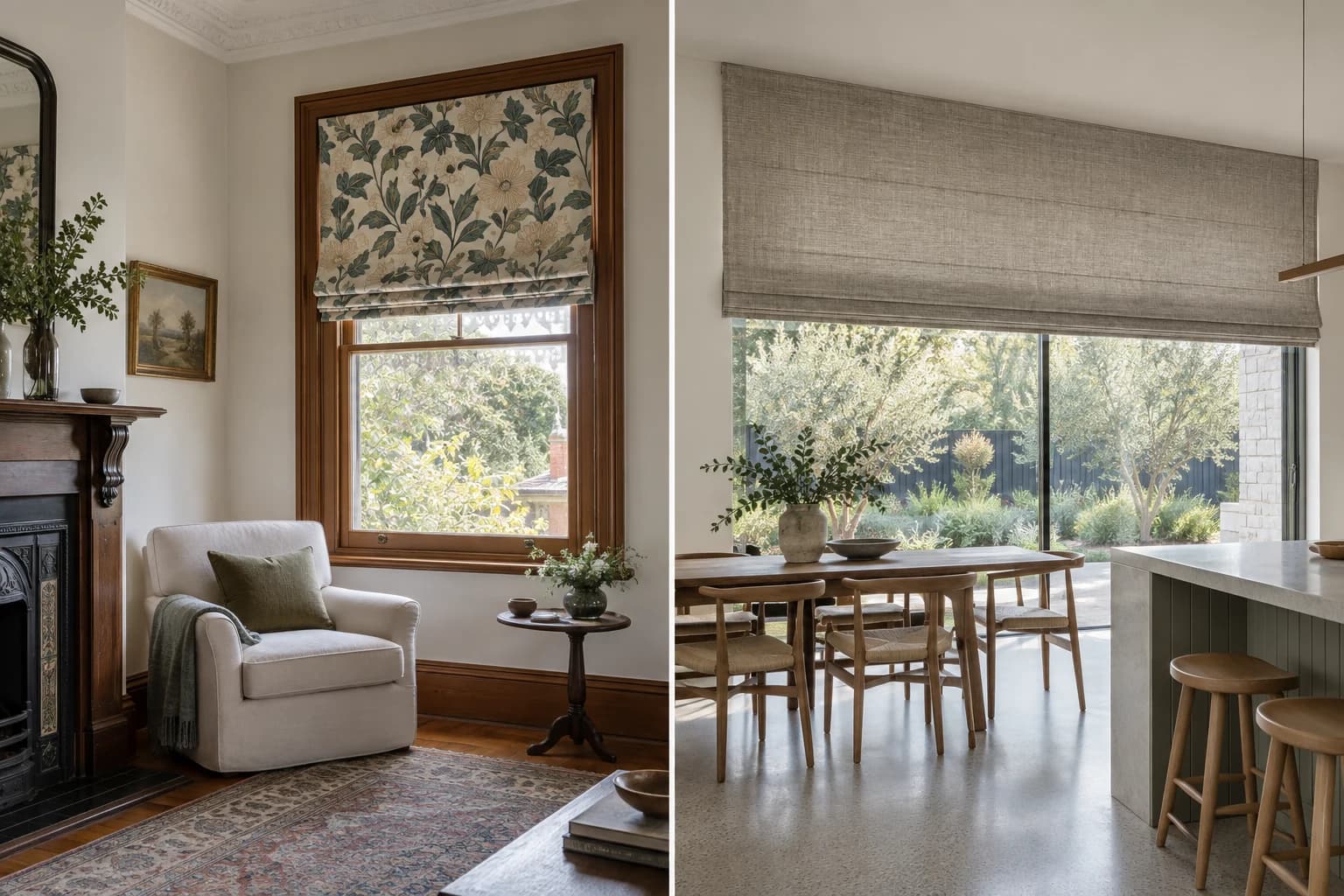
A Roman can sit comfortably within a Sydney terrace, Federation-influenced house or later period renovation. Patterned furnishing fabrics, borders or a stronger colour can respond to timber, decorative plaster and more articulated rooms. The blind should not be described as historically original to Federation architecture. It is a contemporary intervention whose textile and proportion can respect the existing character.
Face mounting may help a Roman establish a deliberate relationship with an architrave; a recess fit may keep important trim visible. That decision should be made window by window rather than following a blanket “heritage” rule.
Contemporary Australian homes
Modern homes often bring together glass, plaster, stone, timber and long, clean junctions. A textured Roman can soften those hard surfaces without obscuring the architecture. Linen-look weaves and restrained colour are common choices, but the actual cloth still needs to be approved for Roman use and the window’s exposure.
In an apartment, the contained footprint can be valuable where furniture sits close to glazing. Privacy, reflected heat, strong sun and access to balcony doors may mean different treatments are needed across the same room. A Roman may be the right answer for a side window and the wrong answer for the main sliding opening.
Roman blinds and curtains together
Romans and curtains are not mutually exclusive. They can be layered at one opening when each has a clear role, or used on different windows within the same room. A patterned Roman might provide a focal textile while plain curtains frame larger glazing. Alternatively, a quiet Roman and matching curtain colour can connect openings of different scales.
The combination needs spatial discipline. Check projection, track position, curtain stack-back and the Roman’s headrail and folds so the systems do not interfere. Repetition of fabric is optional; repetition of a considered material language is usually more useful.
Whole-home planning: create a material language, not product repetition
A resolved home rarely needs the same treatment at every window. Bedrooms may use lined Romans, broad living-room glazing may use sheers and curtains, and service spaces may be better suited to roller blinds. Continuity can come from related undertones, repeated natural texture, consistent top lines and a controlled approach to pattern.
This is also where a Roman’s decorative concentration is useful. One patterned blind in a dining room can carry a colour into nearby cushions; a plain textured Roman in a study can echo curtain fabric in the living room. The products differ, but the interior still reads as one scheme.
Professionally resolved window furnishings can improve privacy, light control, usability, proportion and visual cohesion. Those qualities can make a room feel more complete and considered. They should not be converted into a claim that Roman blinds guarantee an increase in property value or a measurable return on investment.
The strongest contemporary Roman is not selected because the category is fashionable. It earns its place by matching the window, leaving the room usable and contributing exactly the right amount of textile presence.