Edited selection
Fabric and components are narrowed to options that suit the room, the Roman and the proposed dimensions—not simply the sample-book colour.
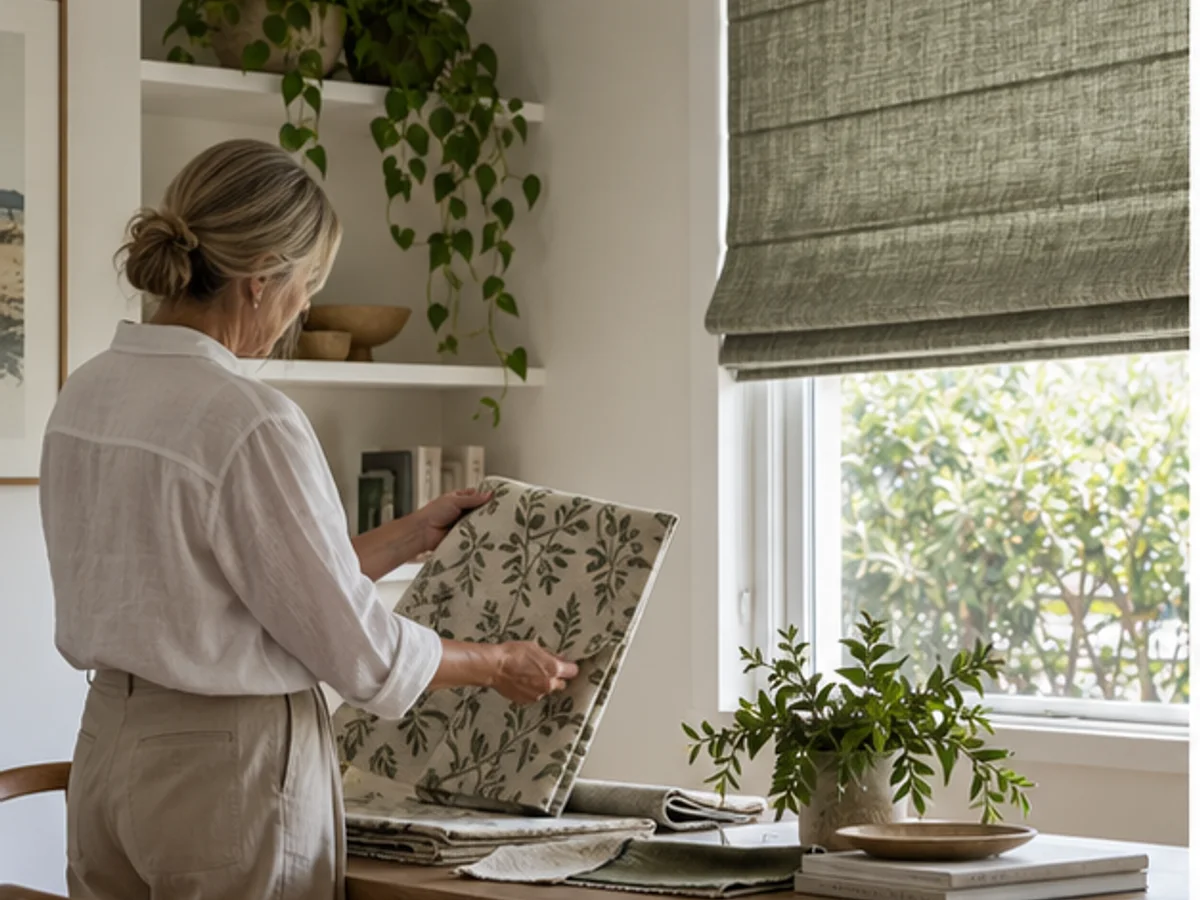
Design your Roman
Colour starts the conversation. Behaviour decides the construction.
A Roman blind asks fabric to lift, fold, stack and settle repeatedly in controlled positions. That means the way a textile behaves can matter as much as its colour or pattern.
Customer question
Colour begins the selection, but weight, weave, stretch, pattern, lining and exposure decide whether the textile can fold, stack and settle credibly at the proposed size.
Fabric as a finished Roman
Backlighting, lining and pattern change the face, body and fold—not only the colour selected from a sample.
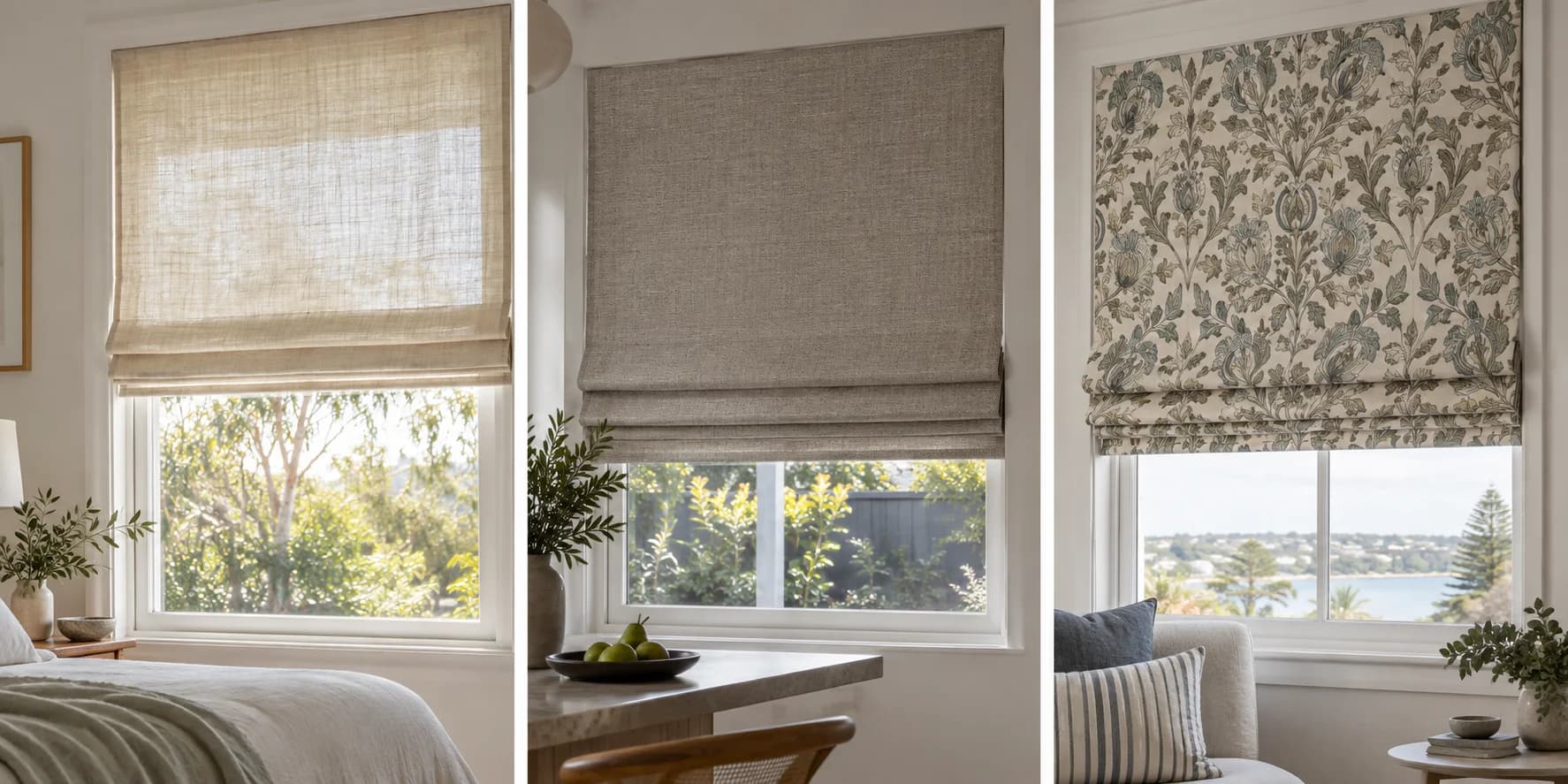
Weight
Very light cloth may reveal support shadows or struggle to form the intended face. A heavy textile can create bulk at every fold and add substantially to the operating load. The useful question is how the complete fabric and lining assembly behaves at the chosen size.
Drape vs structure
Curtains hang predominantly in vertical folds. A Roman asks the same cloth to form repeated horizontal turns, lift as a broad panel and stack at the headrail. A fabric that flows beautifully on a track may be too soft or unstable for the Roman being designed.
Stretch, skew, shrinkage potential and a loose weave can affect the straightness of edges and the repeatability of folds. Linen slub and natural variation can be part of a desirable textile character, but they do not make every movement or edge perfectly uniform.
Pattern
The repeat determines what can be centred and how adjoining pieces relate. A seam can be pattern matched yet still gain thickness or become visible in backlight. Important motifs should be located with the finished folds in mind rather than centred on the flat cloth alone.
Material evidence
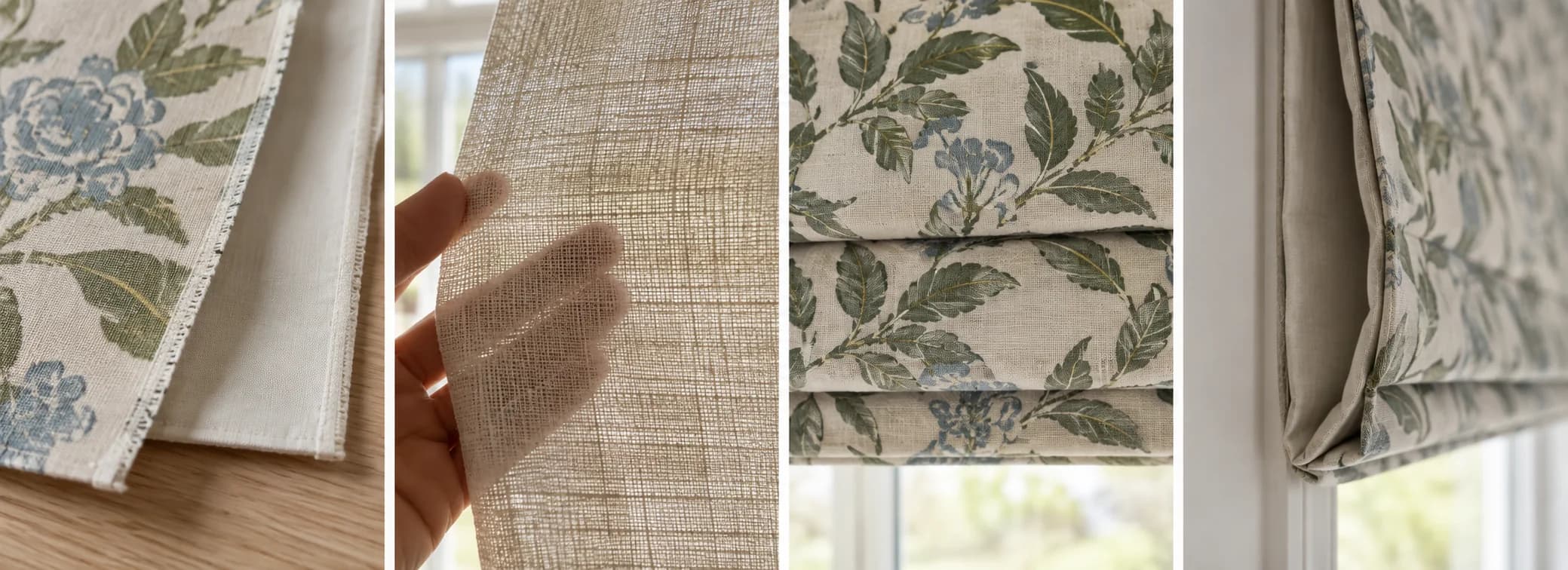
Face & lining
Lining can improve privacy and opacity, support the face and alter how the textile reads against daylight. It also adds a layer that must turn at every fold. The lining is therefore part of the structure, not an afterthought selected by colour alone.
Blockout lining controls light transmitted through the fabric face. Finished room darkness also depends on edge gaps, mounting position and the complete window arrangement.
Where appropriate, interlining can add body and a softer textile presence. It also adds bulk, weight and stack depth, and may be the wrong choice for a compact opening or a fabric that already has substantial body.
Professional judgement · Sample testing
A useful test forms the proposed layers at a representative scale, reviews them against daylight and considers how the material will repeatedly lift and settle. Price or fibre content alone does not predict that behaviour.
If the preferred textile cannot form a stable Roman at the required size, we would compare a more suitable cloth, a different Roman construction or a curtain rather than force the original selection.
The best fabric is not necessarily the most expensive fabric. It is the fabric that behaves correctly for the Roman being designed.
Sun & exposure
A south-facing bedroom and a west-facing living room place different demands on colour, lining and textile selection. Strong direct sun can affect fading, thermal load and long-term material behaviour, so orientation and exposure should be considered before the fabric is approved.
No furnishing textile should be described as fade-proof or UV-proof without verified product evidence. The practical response is to compare the exact fabric, lining, fitting position and the way the household expects to use the blind.
Made to specification
Fabric, lining, construction, finished dimensions and operation are resolved together before making begins. The blind is not forced around a generic off-the-shelf format.
Fabric and components are narrowed to options that suit the room, the Roman and the proposed dimensions—not simply the sample-book colour.
Availability, measurement and system details are coordinated early. Actual timing is confirmed for the chosen materials and scope rather than advertised as a fixed universal lead time.
Level, mounting height, projection, control position and final adjustment determine whether the installed Roman belongs to the architecture.
Before you specify
Cloths with unsuitable stretch, skew, bulk, coating or instability may be poor candidates, but suitability depends on the proposed size, lining and construction. Assessment is more useful than a universal banned-fabric list.
Many linen and linen-look fabrics can work, provided their stability, weave, weight and natural variation suit the design. Expect textile character rather than a rigid panel.
Many benefit from lining for privacy, opacity, body or appearance from outside, but the correct lining depends on the face fabric, construction and room requirement.
Often, where it is compatible with the fabric and construction. It controls transmission through the cloth but does not guarantee complete darkness around the edges.
It can add body and softness where the fabric, window scale and mechanism can carry the extra bulk and weight. It is not an automatic upgrade for every Roman.
A conversation, then a considered specification
Bring a fabric, room image or simply the window. We’ll help assess how the textile, lining, proportion and construction will work together before the Roman is made.