The Roman blind has a familiar name and an uncertain origin story. It is often introduced with a neat tale about cloth hung at windows in Ancient Rome, sometimes wet to catch dust. That story circulates widely in the window-furnishing industry, but repetition is not documentation. We have not found a museum, academic or primary historical source that establishes the modern lifting and folding blind as a Roman invention.
The responsible starting point is therefore less dramatic: people have used textiles to divide, shelter and furnish interiors for centuries, while the specific route to the modern Roman blind is difficult to attribute to one place, date or inventor. Its history is best understood as an intersection of practical shading, the development of furnished European interiors, changing textile production and later mechanical refinement.
What the documented record does show
Textiles were important interior objects long before the contemporary category of “window furnishings”. The Metropolitan Museum of Art notes that medieval curtains could act as room dividers, doorways, bed curtains and sanctuary screens.1 This is useful context because it shows fabric controlling privacy, enclosure and comfort inside buildings; it is not evidence of a Roman blind mechanism.
By the seventeenth and eighteenth centuries, furnishing textiles had become integral to elaborate European rooms. The Met’s scholarship on French decorative arts describes window treatments, wall and bed hangings, upholstery and carpets as sources of colour and texture, protection against draughts and a means of unifying a decorative scheme.2 A window textile was no longer only a barrier. It could participate in the complete design of a room.
Trade and manufacturing broadened the available vocabulary. The Met records strong British demand for Indian chintz and calico as dress and furnishing fabrics in the late seventeenth century.3 Surviving British curtains and bed hangings show the circulation and reinterpretation of floral textiles across cultures. These objects help explain how pattern became embedded in domestic furnishing, but they do not provide a direct date for the first Roman blind.
During the nineteenth century, published interior-design portfolios disseminated increasingly elaborate ideas for window drapery. The Met’s Living in Style exhibition records colour lithographs of canopy beds, window and chimney draperies and textile-clad furniture, while noting the period’s taste for historical and international references.4 At the same time, British Arts and Crafts designers developed furnishing fabrics as serious elements of domestic interiors. The V&A records William Morris textiles used for curtains, wall hangings and coordinated schemes, including patterned fabrics designed during the 1870s and 1880s.5
This documented history explains the decorative environment from which fabric window treatments evolved. It still does not identify a single moment when a flat textile panel, lifted into horizontal folds by cords, became known as a Roman blind.
The modern lifting blind
The modern Roman combines three ideas: a flexible face, a system that lifts the textile at repeated positions, and a headrail or support that carries the assembly. Lowered, it can present a relatively flat or deliberately folded face. Raised, it collects into horizontal folds or soft cascades.
Patent literature confirms that the construction continued to be engineered rather than remaining a single fixed design. A 1992 US patent describes an “improved window covering of the Roman shade type”, and later patents discuss cord guides, headrails, rolling mechanisms and variations on the folded face.6 Patents prove that named Roman-shade systems existed and were being refined at those dates; they do not prove when or where the category began.
Twentieth-century interior use also widened as domestic architecture, textile production and hardware changed. Furnishing fabrics moved between traditional pattern and modern abstraction. The V&A’s account of post-war textiles shows how mid-century designers brought contemporary art, new colour and new printing approaches into fabrics for homes.7 A Roman blind could therefore carry the same decorative textile language as curtains and upholstery while occupying less wall and floor area.
Motorisation is a later operational development rather than a different decorative species. The blind still depends on fabric, folds and proportion, but the lifting work is transferred to a compatible powered system. Contemporary motor selection remains tied to the carrier product, blind weight and headrail rather than to style alone.8
Design traditions, not national standards
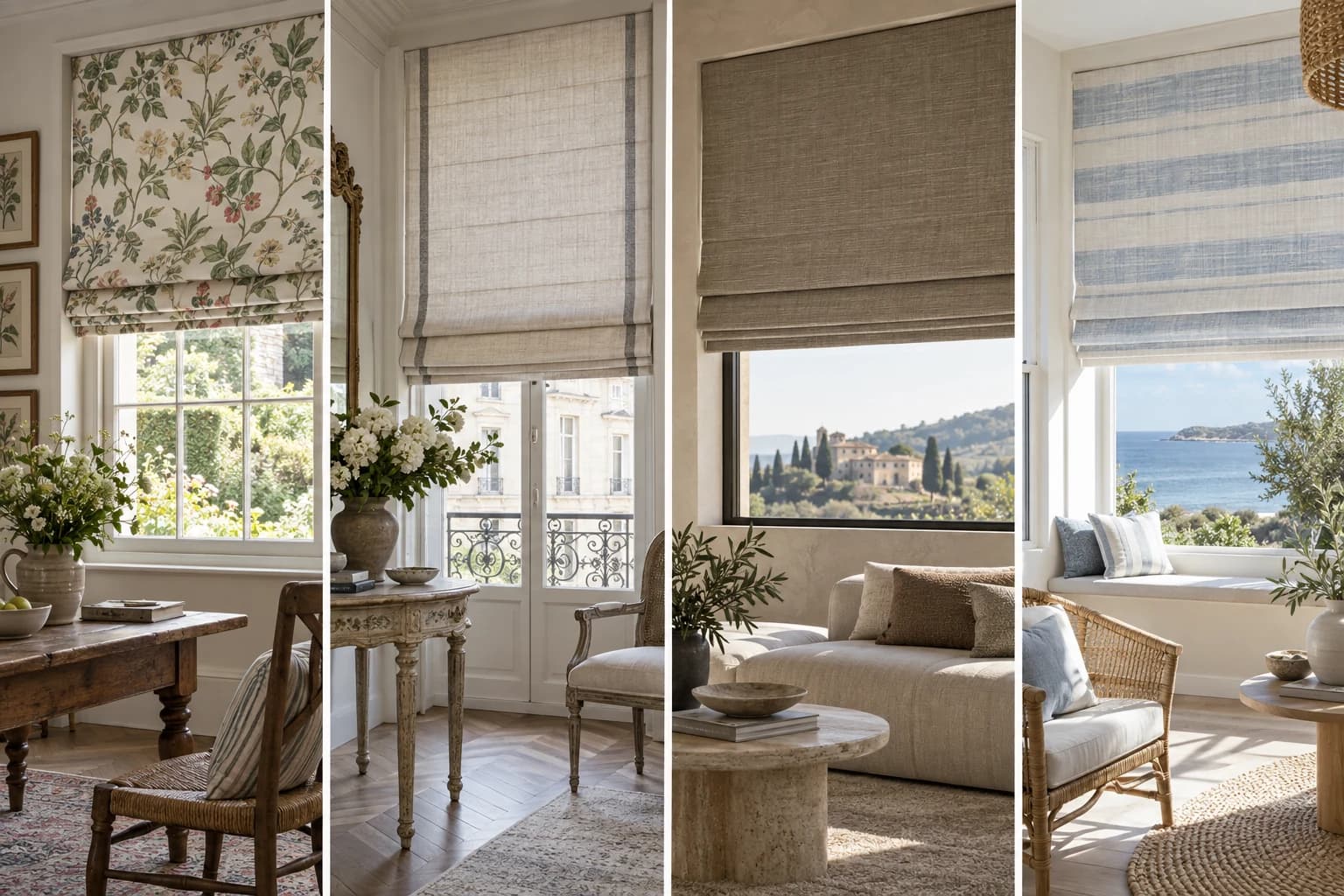
It is tempting to divide Romans into British, French, Italian or Australian types. Those labels suggest technical standards that do not exist. It is more accurate to discuss tendencies within broader interior traditions.
English-inspired rooms
British furnishing history offers a rich language of printed textiles, florals, stripes, checks and coordinated rooms. The V&A’s record of Morris and later Arts and Crafts pattern shows that curtains, covers, hangings, wallpaper and rugs could work together rather than as isolated products.5 In an English-inspired room today, a Roman may carry a patterned furnishing fabric, a border or a trim, and it may be paired with curtains. That is a contemporary design choice informed by a textile tradition—not proof of an ancient “English Roman” category.
Continental European interpretations
European contemporary interiors can suggest a different emphasis: linen and linen-look textures, quieter palettes, simpler detailing and integration with architecture. These are broad design observations, not claims that France or Italy specifies Romans in one prescribed manner. A restrained Roman can belong to a plaster, timber or stone interior because the textile brings surface and filtered light without dominating the elevation.
North American interpretations
North American residential design frequently uses Romans as a field for colour and pattern, including decorative borders, relaxed lower profiles and larger window groupings. Again, the range is too broad for a national formula. The useful point is that the Roman can move from restrained architectural treatment to emphatic decorative furnishing while retaining the same basic vertical operation.
Australian interpretations
In Australian homes, Romans often respond to strong natural light, compact rooms, furniture below windows and a preference for material texture. Linen looks, muted colour, pattern and timber can sit comfortably in both renovated and contemporary architecture. The specification still needs to account for exposure, privacy, lining, open-window operation and the raised stack.
Australian design also demonstrates that Romans and curtains are not opposing camps. A Roman may resolve a smaller bedroom or study window while sheers or curtains address broad glazing elsewhere. The connection can come from colour, textile character and aligned proportions rather than repeating one product at every opening.
From curtain language to Roman language—and back again
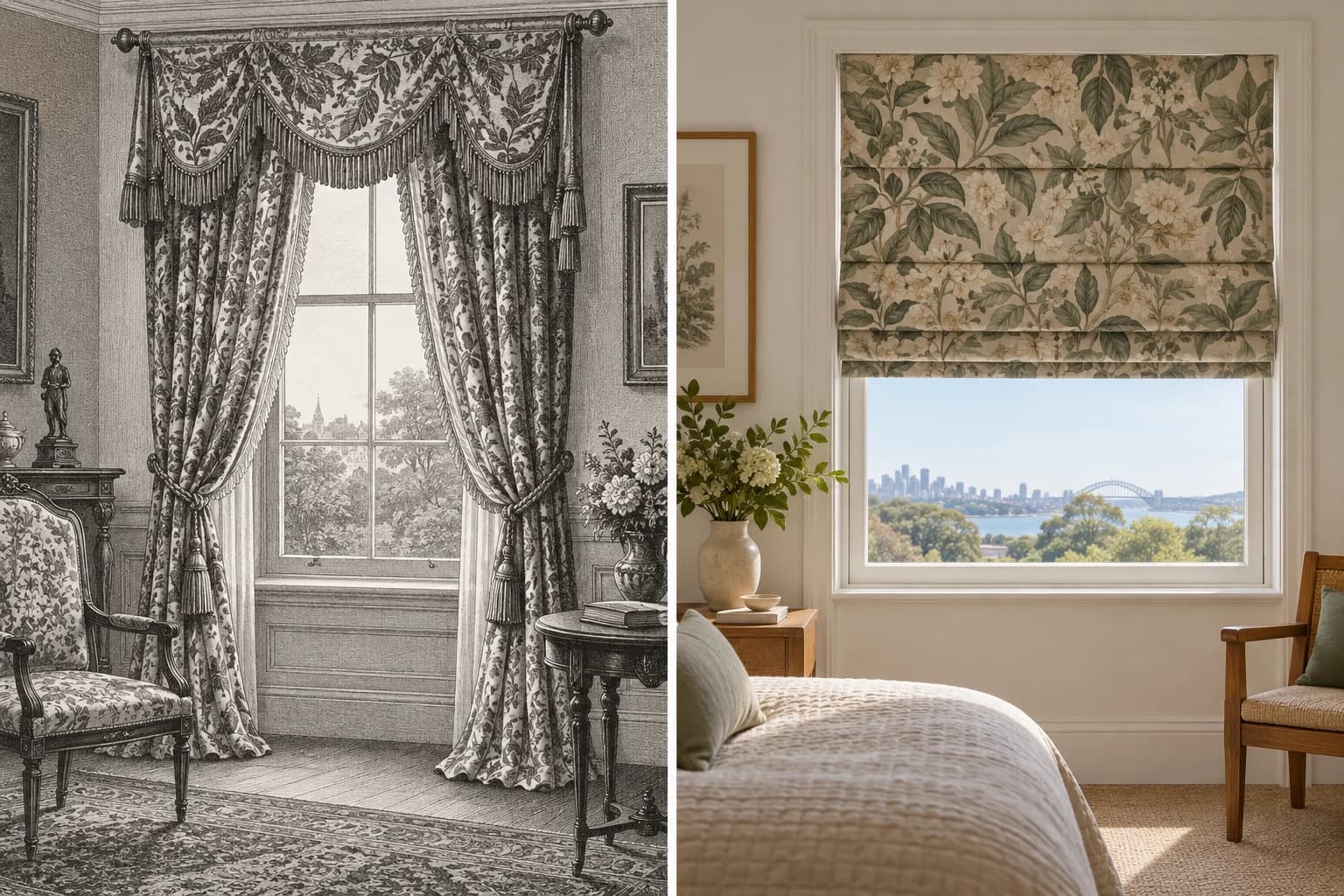
The continuing link between Romans and curtains is important. Both begin with cloth, and both ask how that cloth should manage light, privacy and visual weight. Curtains fall vertically and can frame a whole wall; Romans rise within or across an opening and place their fabric in a contained rectangle. The same furnishing pattern can behave very differently at those scales.
Decorative trims, contrast borders and patterned repeats made Romans useful as concentrated textile details. More restrained versions brought texture without the volume of full-length drapery. Later motorisation changed how they could be operated on high or repeated windows, but it did not remove the need to design the folds and fabric properly.
The Roman blind’s real history is therefore not one clean line from an ancient invention to a modern product. It is part of a longer history of using cloth to shape interiors, of making windows decorative as well as practical, and of adapting lifting hardware to the expectations of each period.
What remains uncertain
We can document centuries of furnishing textiles, window draperies, changing pattern and later mechanical patents. We cannot yet document a reliable first inventor, date or country for the modern Roman blind. Until stronger evidence emerges, the Ancient Rome story should be identified as industry folklore rather than presented as fact.
That uncertainty does not make the history less useful. It reveals the Roman for what it is: a durable design idea shaped by textile culture, interior fashion, making practice and mechanical improvement—not a museum object frozen in one national style.
Continue exploring
Sources
- The Metropolitan Museum of Art, Jerusalem, 1000–1400: Every People Under Heaven, selection of furnishing and clothing textiles.
- The Metropolitan Museum of Art, The Wrightsman Galleries for French Decorative Arts, Textiles and Leather.
- The Metropolitan Museum of Art, Interwoven Globe.
- The Metropolitan Museum of Art, Living in Style.
- Victoria and Albert Museum, William Morris textiles and Pattern design after William Morris.
- Google Patents, US5129440A — Roman shade and US20070235147A1 — Roman or hobble shade.
- Victoria and Albert Museum, Post-war textiles.
- Somfy Australia, Motor selection is easier than you think.