Motorised Curtains · Sydney
Motorised Curtains Sydney
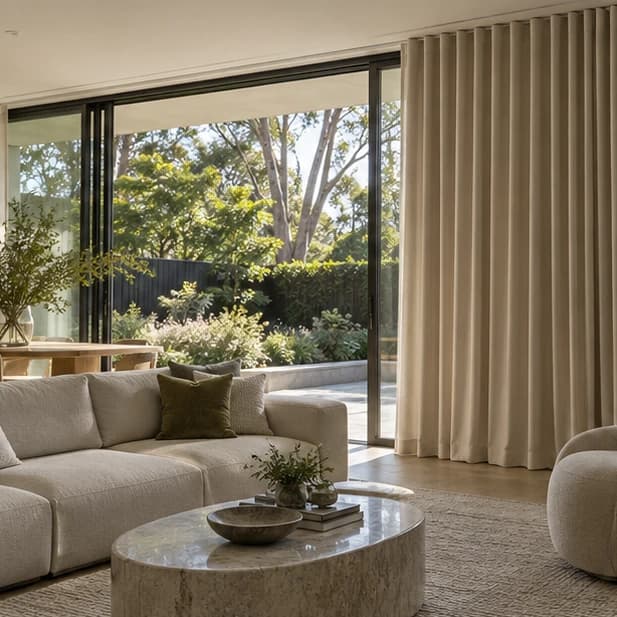
Motorisation should disappear into the room.
A motorised curtain is first a curtain, then an operating system. The track, fabric, lining, finished weight, stack, power and controls should work together quietly.
CCBD considers the complete window before recommending how—and whether—to motorise it.
Useful by design
Why motorise curtains? When it earns its place.
Motorisation helps most when a curtain is very wide, heavy, tall, hard to reach or moved often. It can simplify large sliding doors, double-height glazing, daily western-sun control and independently operated sheer and blockout layers.
Not every curtain needs a motor. A small, easy-to-reach curtain opened morning and evening may be simpler and better value manually. Powered operation should improve the way the room is actually used.
When are motorised curtains worth it? ↗The complete treatment
Start with the curtain, not the motor.
Fabric, lining, heading, fullness and width determine the finished curtain weight. The track span, opening direction, stack and daily operating frequency matter too.
A manual S-fold curtain is not automatically motor-ready: its heading, carriers and track must suit the proposed motor. Heavy treatments also require their own load and fixing assessment.
Select the motor and track for the completed curtain rather than treating them as accessories added afterwards.
Power decision
Battery or hardwired motorised curtains?
In a finished home, a suitable rechargeable system may avoid opening walls. During a renovation, investigate hardwired power before ceilings close. In a new build, plan the motor side, curtain pocket, wiring, controls and service access together. Neither approach is universally better.
Swipe the table sideways to compare both power options.
| Consideration | Rechargeable / battery | Hardwired |
|---|---|---|
| Finished home | Often easier to retrofit | May need new electrical work |
| Renovation or new build | Still possible | Worth planning before finishes close |
| Charging | Plan a reachable connection | No routine charging |
| Electrical provision | Usually less new wiring | Confirm supply with the electrical plan |
| Retrofit disruption | Often lower | May be higher in a finished room |
| Heavy or wide curtain | Model and track dependent | Model and track dependent |
| Future servicing | Keep battery and motor accessible | Keep motor and controls accessible |
| Best choice | Depends on the window and use | Depends on the window and use |
Charging interval, capacity and control compatibility vary by model. New fixed wiring in NSW is work for a licensed electrical worker. Read the full power guide ↗
Designed into the room
Good motorisation begins before the curtain is made.
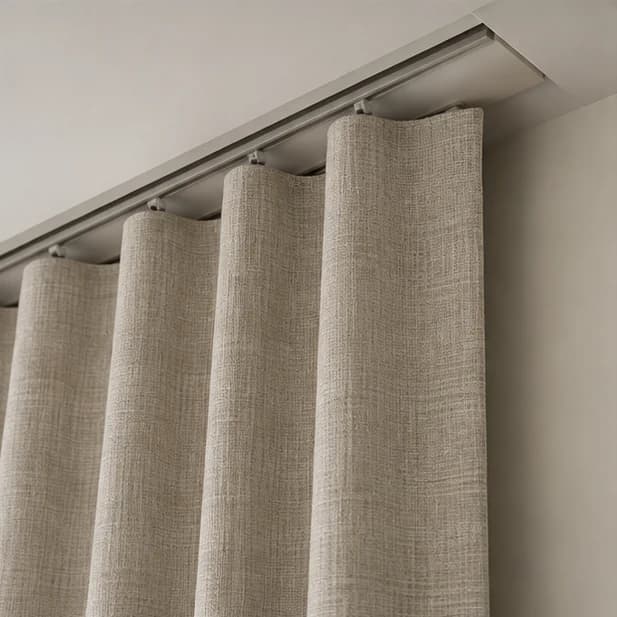
- Track & stack
- Ceiling-mounted, recessed or exposed according to the room. Allow support, motor space, open stack, door-handle clearance and a way to reach the track later.
- Power
- Locate a socket, fixed supply or reachable charging point before closing ceilings or finalising joinery. The actual motor determines the electrical requirement.
- Control
- Remote, wall control or a compatible home system—chosen for the daily routine. Phone, voice and scheduling features depend on the exact motor and hub.
- Curtain
- Fabric, lining, heading and fullness set the load and appearance. A premium motor does not rescue a curtain or track specified for the wrong opening.
Independent specification
Which motorised curtain system is best?
There is no single best motor for every Sydney home. Compare the finished curtain load, track span, operating frequency, noise, power, controls, home integration, service route, warranty and total installed cost—not the logo alone.
Best value does not mean the cheapest motor.
The system is fabric + lining + heading + track + motor + power + control + installation + future service. An underspecified motor can be poor value; so can elaborate automation for one small window.
Selected Somfy systems may suit projects where their curtain-specific range, controls or integration pathway answer the brief. A simpler proven system can offer better value elsewhere. The exact model, capacity and service terms belong in the proposal.
Compare motor systems ↗Large glazing & sliding doors
The wider the curtain, the more the whole system matters.
Powered operation can make a wide or tall curtain easier to use, but the specification must account for finished weight, track span, structural fixing, one-way or centre opening, fabric stack, motor side and service access.
Check the open curtain against sliding-door handles and the walking route. If the side stack compromises access, a motorised roller blind may be the more compact solution.
Read the large-window guide ↗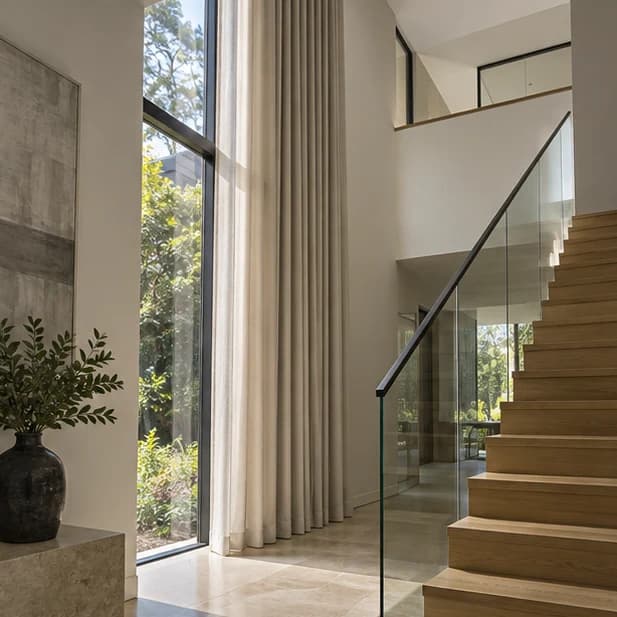
One room · Independent layers
Two curtains. Different routines.
A sheer and a lined or blockout curtain can be planned for separate control: both open for outlook, sheer closed for daytime screening, or both closed for evening privacy and greater room darkening. The result depends on the fabric and fitting, not the motors alone.
If both layers move daily, separate motors may be worthwhile. If one layer stays in place, motorising only the frequently used layer may be better value. A double treatment still needs enough track separation and stack space for each curtain.
Plan a double system ↗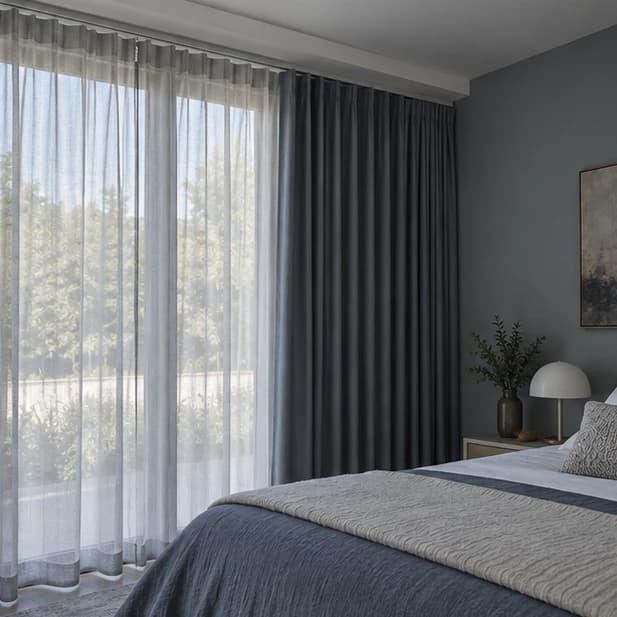
Before the ceiling closes
Planning motorised curtains during a renovation or new build.
The best time to coordinate curtains and power is while the opening can still change. Bring plans and approximate dimensions to CCBD before plasterboard and joinery are finalised.
Full renovation checklist ↗Confirm together
- Curtain type, fabric, lining and likely finished weight
- Single treatment or independent sheer and blockout layers
- Track line, support, recess or pelmet and open stack
- Opening direction, motor side, power and controls
- Access to the motor, track and controls for later service
Specify once, service later
What should be considered before motorising curtains?
Most avoidable problems are planning mismatches, not a lack of technology. Ask these questions before the curtain is made or a ceiling detail is approved.
- Motor chosen before the finished curtain load is known
- Power discussed after ceiling or joinery is complete
- Charging point hidden behind a high or crowded stack
- Curtain stack blocking a sliding door or window handle
- Double tracks with insufficient separation
- App or voice compatibility assumed rather than checked
- Motor concealed without a practical replacement route
- Motorisation added where manual operation would be simpler
Knowledge & Advice
Take the decision deeper, one question at a time.
Focused guides explore power, system choice and alternatives without turning this room-led page into a motor catalogue.
Battery vs Hardwired Motorised Curtains: A Sydney Homeowner’s Guide
Somfy vs Other Curtain Motors: Choosing a Suitable System
Motorised Curtains vs Motorised Roller Blinds
A motorised Roman blind may suit a smaller, design-led opening; a roller blind is more compact where drapery is unnecessary. Compare these with the full Roman blind range before settling on a motor.
Explore all eight motorised curtain guides ↗Customer decisions
Questions worth asking before the quote.
These answers explain the principle. Actual capacity, charging, manual operation and integration are confirmed for the named system in the proposal.
Is it worth doing?
Are motorised curtains worth it?
They are most valuable where reach, weight, width or frequent operation makes a manual curtain awkward. A small, easily reached curtain opened twice a day may be simpler and better value manually. Start with the window and daily routine, then price the complete treatment.
When does motorisation make the biggest difference?
Consider it for tall or wide glazing, heavy lined curtains, large sliding doors, independent sheer and blockout layers, or multiple treatments operated together. The benefit rises when a curtain is used often or hard to reach; it is not a requirement for every window.
How much do motorised curtains cost in Sydney?
There is no useful single price without a measured specification. The total includes fabric, lining, making, track, motor, power, controls, installation and commissioning. Ask for an itemised quote showing what is included, whether electrical work is separate, and how future servicing is handled.
How much does motorisation add to the cost of curtains?
Compare the same finished curtain with manual and motorised track options. The difference can include motor, compatible track, controls, power provision and commissioning—not just the motor unit. A large or double-layer treatment may change the track and fixing specification as well.
Should I motorise every curtain in the house?
Usually assess rooms separately. Daily-use living-room glazing or hard-to-reach bedroom curtains may justify it; a rarely moved guest-room curtain may not. A room-by-room schedule avoids paying for controls and motors that offer little practical benefit.
Power, charging & service
Battery or hardwired motorised curtains—which is better?
Battery or rechargeable systems can reduce disruption in a finished home; hardwired power is worth investigating when ceilings or walls are already open. Neither is universally stronger. Confirm the chosen motor’s load capability, track configuration, charging access and expected use before deciding.
How often do rechargeable curtain motors need charging?
It depends on the specific motor and battery, finished curtain load, track arrangement and operating frequency. Request the selected model’s Australian product information and a realistic charging plan rather than relying on a generic interval.
Where is the charging point?
Its position depends on the selected motor and battery arrangement. Locate and test access before ordering: a concealed connection is little help if a ladder is needed each time or the curtain stack blocks it. The handover should identify the connector and charging method.
Do motorised curtains need an electrician?
A rechargeable system may use an existing charging point without new fixed wiring. If new or altered fixed electrical wiring is required in NSW, that work belongs with a licensed electrical worker. Confirm the motor’s supply requirement before the electrical plan is finalised.
What happens during a power outage?
A mains-powered system normally loses powered operation until supply returns; a charged battery system may still operate. Manual operation during an outage is model-specific, so ask for the exact motor’s instructions and demonstrate the approved procedure at handover.
What if the motor fails, and can the curtain be moved manually?
First distinguish power, battery, remote, pairing and track faults from a failed motor. Some systems provide an approved manual-release or touch-motion function; others do not. Preserve access to the motor and controls, and obtain the model-specific service and replacement pathway.
How long do curtain motors normally last?
Service life varies with model, load, use, installation and maintenance. A warranty period is not a lifetime prediction. Compare the written product warranty, local support, replacement availability and access cost for the proposed system.
Curtain & window fit
Can existing curtains be motorised?
Sometimes, after checking their finished weight, heading, track compatibility, fabric condition and fixing. The existing track may need replacing, and the stack or opening direction may need redesign. Measure the actual curtain before choosing a motor.
Can a finished Sydney home be retrofitted without opening walls?
Often a suitable rechargeable or plug-in arrangement can avoid new concealed wiring, provided the motor suits the curtain and charging or socket access is acceptable. Track fixing and wall condition still need assessment; a clean retrofit is a site-specific result, not a promise.
Can sheer and blockout curtains both be motorised?
Yes, where each layer has adequate track separation, fixing, clearance and a compatible motor and control. If both move independently every day, two systems may be useful. If the sheer is rarely moved, motorising only the blockout layer can be better value.
Can S-fold curtains be motorised?
They can when the heading, carriers, track and motor are specified as one compatible system. Check wave spacing, open stack, direction of travel and fabric weight; an existing manual S-fold track is not automatically motor-ready.
Can very wide or heavy curtains be motorised?
Potentially, but the answer comes from the selected system’s rated load and track configuration, not a universal width claim. Finished fabric and lining weight, joins, opening direction, structural fixing and service access all need checking before approval.
Where is the motor installed, and how much space does the track need?
The motor is normally associated with an end of the track, with position determined by the system and opening direction. Allow space for the motor body, curtain stack, recess or pelmet, door handles and access for future removal; exact dimensions come from the chosen track drawing.
Are motorised curtains suitable for bedrooms?
They can be useful for high windows, daily morning and evening routines or separate sheer and blockout control. For sleep, also assess fabric opacity, edge gaps, track position and operating noise; motorisation alone does not create room darkness.
Controls & alternatives
Which curtain motor brand is best—and is Somfy worth the extra cost?
There is no best brand for every window. Somfy can be worth considering where its curtain-specific range, compatible controls, integration or support pathway answer the brief; a simpler proven system may offer better value for a straightforward opening. Compare exact models, not logos.
Can curtains work with Google Home, Alexa or Apple systems?
Some motor, protocol and hub combinations support selected voice or home-automation platforms. Compatibility must be confirmed for the exact model, gateway and software version proposed. Do not assume that a motor with a remote also supports every app or voice platform.
Do motorised curtains need Wi-Fi?
Basic remote or local wall control may operate without home Wi-Fi, depending on the chosen system. App control, remote access, schedules or voice integration can require a compatible hub and network connection. Specify the desired control method before selecting the motor.
Remote, wall switch, app or voice—which is better?
Choose the control people in the room will actually use. A wall control is easy to find, a remote suits one room, and an app or voice can help with grouped routines when compatible. Confirm what still works if internet access or a hub is unavailable.
Can curtains open and close on a schedule?
Many compatible systems can support timed routines through a controller or hub, but scheduling is not universal. Confirm the exact motor, controller, network dependency and desired behaviour before ordering—especially for layered curtains that need different routines.
Should I plan motorisation before a renovation?
Yes. Before plasterboard or joinery closes, decide the treatment and approximate finished load, track and stack position, motor side, power location, controls and future access. Late decisions can force exposed wiring or awkward servicing.
Motorised curtain, roller blind or Roman blind—which suits the window?
Choose a curtain for textile softness and large glazing where side stack is acceptable; a roller blind can be more compact for a narrow everyday window; a Roman blind gives a more furnished look but creates a raised stack. Compare daylight, privacy, clearance and operating frequency before comparing motors.
Specification references
General selection guidance is informed by Somfy Australia’s curtain checklist and fixed-wiring guidance from the NSW Government. These sources do not substitute for confirming the exact motor and site specification.
Your next step
Bring us the window.
We’ll work through the possibilities.
Share room photographs, approximate dimensions or plans, and tell us what you would like to change. We’ll work through the light, privacy, fabric and practical requirements before recommending the right treatment.
Arrange an in-home measure and quote.
Talk with us about fabrics, styles, light, privacy and planning your window furnishings.
Imagery includes AI-generated design illustrations, not completed CCBD projects or photographs of the CCBD workroom.