THE FIRST DECISION
Start with the room, not the mechanism
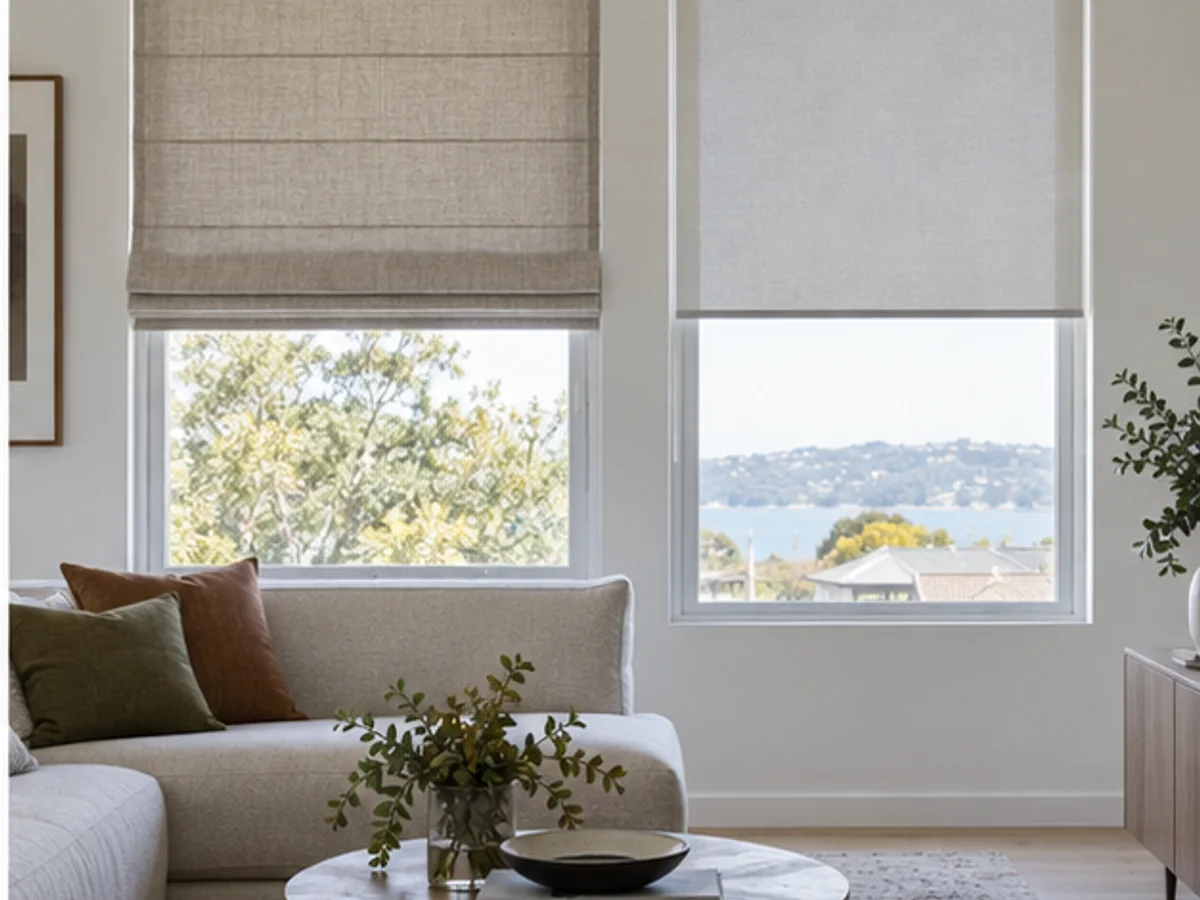
A Roman is a soft furnishing. Even when its folds are clean and restrained, the face fabric contributes texture, colour and a visible stack to the interior. A roller is usually quieter: its fabric rolls around a tube and leaves a smaller visual footprint when raised. That distinction is more useful than treating one as an upgrade from the other.
Consider the wall around the window, nearby furniture and how much textile the room already contains. A Roman can give a single window enough presence without adding full curtains. A roller can be the better answer where joinery, a view or a deliberately minimal scheme should remain dominant.
ROMAN BLINDS
Fabric expression comes with a larger stack
Romans make furnishing fabric visible across the window, so pattern placement, lining and fold depth become design decisions. When raised, that fabric gathers into a stack above the glass. The stack can be attractive, but it must be allowed for around opening sashes, views and smaller windows.
Construction is also more involved than it first appears. The face fabric, lining and lifting system need to move together repeatedly. A cloth that looks suitable on a sample hanger may be too unstable, bulky or pattern-sensitive for the proposed blind.
ROLLER BLINDS
Compact and practical can be exactly right
A roller is useful where compact operation, a restrained appearance and straightforward daily control are the priorities. It can sit behind curtains as a secondary privacy or light-control layer, or stand alone where the room does not need a decorative fabric treatment.
The surface behaves differently from a Roman. Roller fabrics are selected to roll and track consistently, and decorative furnishing fabrics are not automatically interchangeable with them. Side gaps, roll direction, tube position and the relationship to handles still affect the finished result.
LIGHT, PRIVACY & USE
Compare the complete treatment
Neither blind should be chosen from its fabric opacity alone. Recess gaps, face-fit coverage and the path of light around the headrail affect privacy and room darkening. A Roman may offer more furnishing-fabric choices; a roller may suit frequent operation or a window where preserving open glass matters more.
For a wide or heavily used opening, review operating effort, hardware capacity and how the blind will look part-raised. Motorisation can assist either treatment, but it does not correct an unsuitable fabric, poor fit or unresolved proportions.
Before you decide
Questions & answers
Is a Roman blind always more expensive than a roller blind?
A Roman generally involves furnishing fabric, lining and more detailed making, but a meaningful comparison needs the actual sizes, fabrics, controls and installation. Compare complete specifications rather than product names alone.
Can Romans and rollers be used in the same home?
Yes. A coordinated scheme can use Romans where textile presence matters and rollers where compact control is more useful. Colour, top lines and operation can still be planned as one whole-home system.