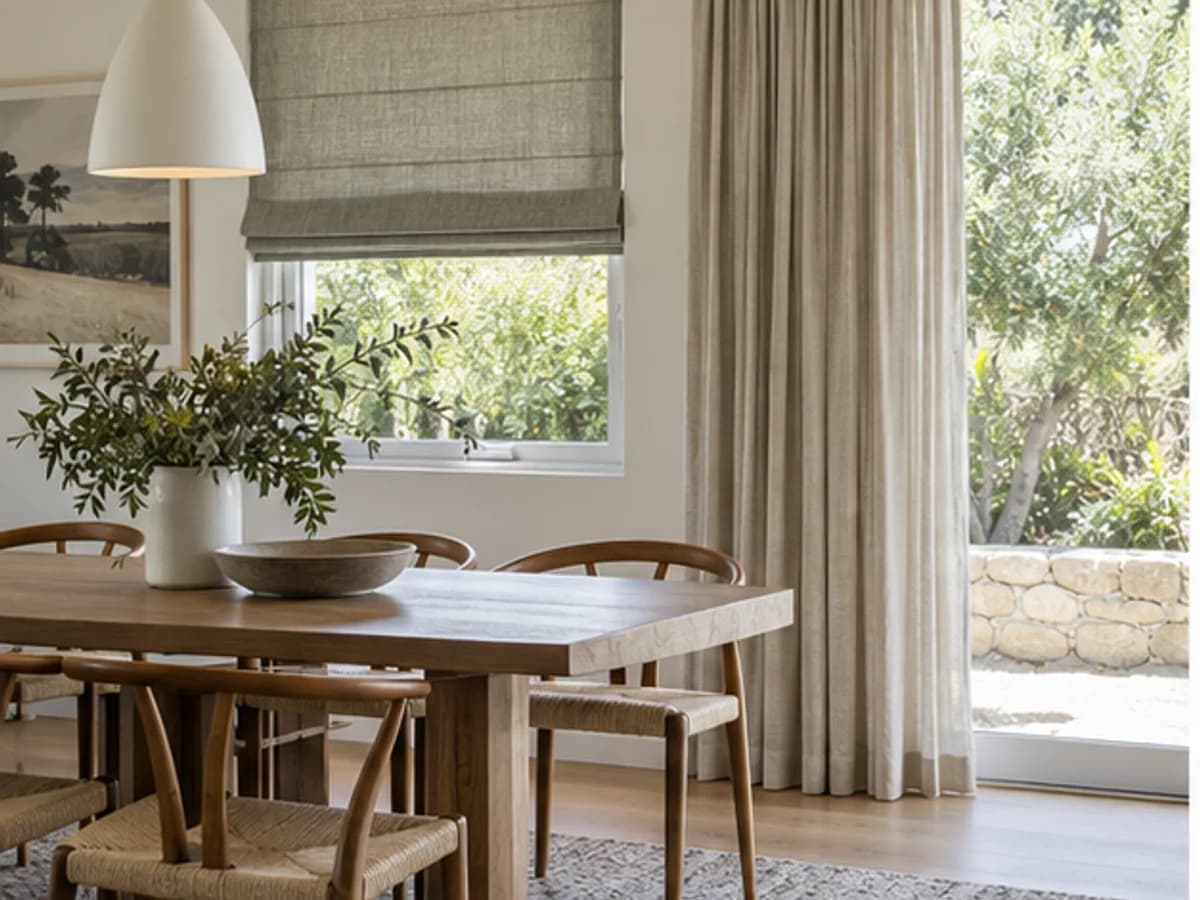
HOW THEY SHAPE THE ROOM
One sits on the window. The other can frame the wall.
A Roman usually reads as part of the opening. It keeps the floor and adjacent wall clear, which can be useful above joinery, beside furniture or where a full curtain would feel visually heavy. Because the fabric remains within a compact composition, colour and pattern can have considerable impact.
Curtains can extend beyond the opening and alter the apparent height or width of the architecture. They can soften large areas of glazing, cover multiple door panels and create a continuous vertical line from ceiling to floor. That extra fabric also needs stack-back space when open.
WHERE ROMANS WORK WELL
A tailored answer for contained openings
Romans often suit individual windows, built-in seating, bedrooms with furniture close to the wall and rooms where the fabric should be visible without extending to the floor. They can be designed to sit within a recess or mounted over the architrave when greater coverage or a stronger visual presence is needed.
The raised stack remains at the top of the opening. On a short window, or where the upper glass is important for daylight, that needs deliberate planning. Very wide openings and frequently used doors also deserve a different discussion.
WHERE CURTAINS WORK WELL
More fabric, more wall and different possibilities
Curtains can be more suitable for broad glazing, sliding doors and rooms where the window treatment should frame the architecture. They also allow different heading, fullness, return, lining and track decisions. A sheer and lined curtain can create layers that move independently across a large opening.
That flexibility uses wall space. Stack-back, track position, furniture clearance and floor length all influence whether the treatment will operate well. A curtain is not automatically the softer or simpler option; its scale must be resolved with the room.
LAYERING
Sometimes the answer is not either/or
A Roman and curtains can work together where each has a clear purpose. The Roman may provide a patterned focal point or daytime adjustment while curtains frame the room, add softness or support evening privacy. The top lines, fabrics and mounting planes should be coordinated so the two treatments do not compete or interfere when moving.
Layering should solve a real design or performance need. Adding more fabric without considering stack, projection and control can make a window feel crowded rather than resolved.