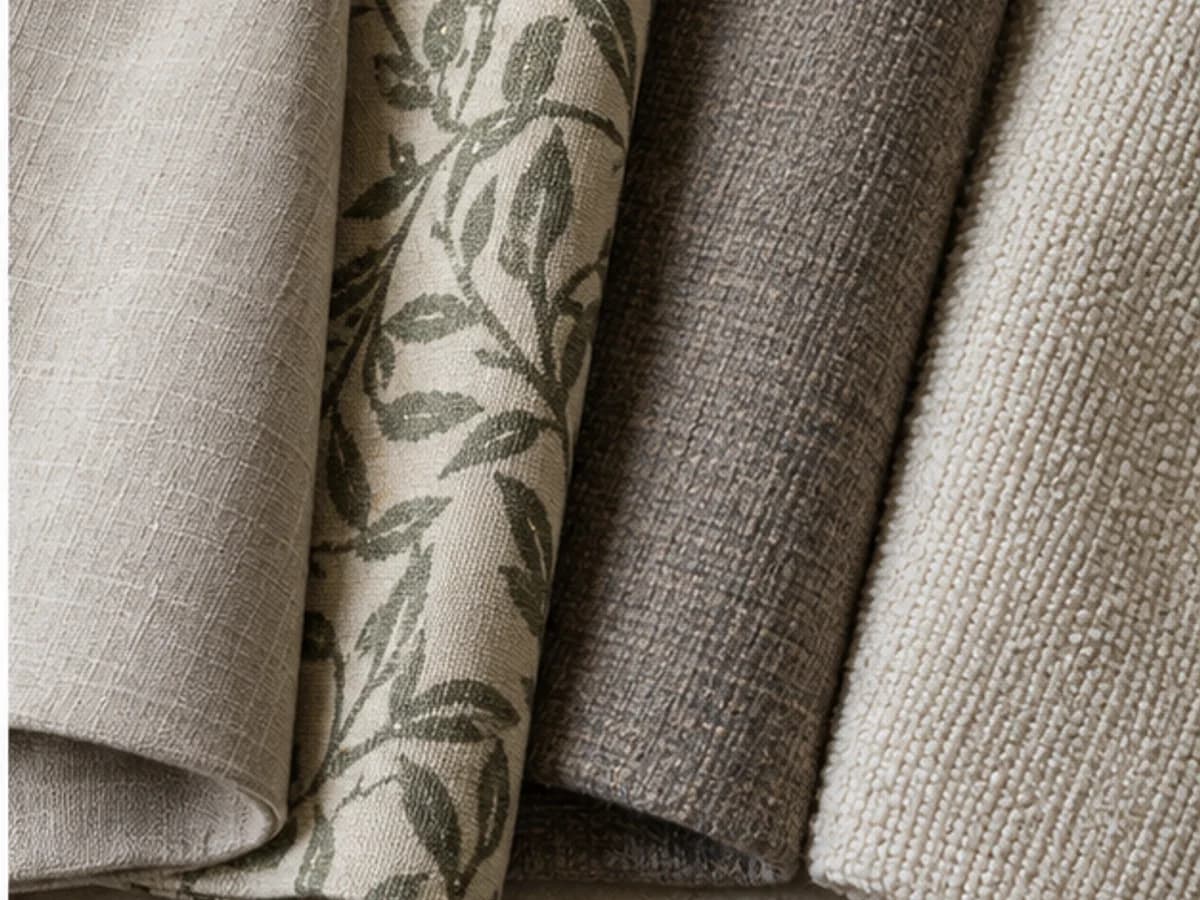
FABRIC BEHAVIOUR
Composition is only the beginning
Linen, cotton, polyester, wool and blended cloths can all be considered, but fibre content alone does not predict the finished blind. Weave density, stretch, bias movement, surface texture and finishing affect how the fabric forms a fold and whether it settles consistently after operation.
A stable medium-body textile is often a useful starting point because it can hold a controlled shape without creating excessive bulk. That is a principle, not a rule. The appropriate body depends on the finished width, drop, lining and whether the intended Roman is classic, relaxed or waterfall.
DRAPE & STRUCTURE
A beautiful curtain fabric may not make a good Roman
Curtains are expected to fall vertically. A Roman asks the cloth to travel, bend and stack horizontally around repeated lifting positions. A very fluid cloth may lose the intended fold definition; a rigid or heavily textured cloth may become bulky at the stack and turned edges.
Relaxed Romans rely more visibly on drape, while classic constructions usually need enough stability for deliberate horizontal lines. Waterfall folds add depth across the face and can magnify fabric bulk. The style and textile must therefore be assessed together.
PATTERN & TEXTURE
The fold becomes part of the pattern
A patterned Roman displays a large flat area when lowered and interrupts that pattern as it rises. Repeat size, centre line, seam position and the relationship between several blinds should be resolved before cutting. A small sample may not reveal enough of the repeat to judge the finished scale.
Slubby linens and pronounced weaves can give a Roman valuable material character, but irregular yarns may make a perfectly mechanical appearance neither possible nor desirable. The natural variation should be understood and accepted as part of the specification, not discovered at installation.
LINING & SAMPLING
Assess the complete textile assembly
Lining can add privacy, body and stronger light control, but it also changes weight, thickness and fold behaviour. Interlining may be appropriate for selected decorative briefs; it is not a universal upgrade and can create unnecessary bulk in the wrong construction.
Review a generous sample in the room, against daylight and under evening lighting. Form a fold by hand and look at both face and reverse. Supplier suitability guidance and a maker’s assessment are more informative than choosing from a small colour swatch alone.
Before you decide
Questions & answers
Is the most expensive fabric usually the best choice?
No. The best choice is the textile that behaves correctly for the intended style, size, lining and room. Price does not establish weave stability, fold quality or suitability for repeated operation.