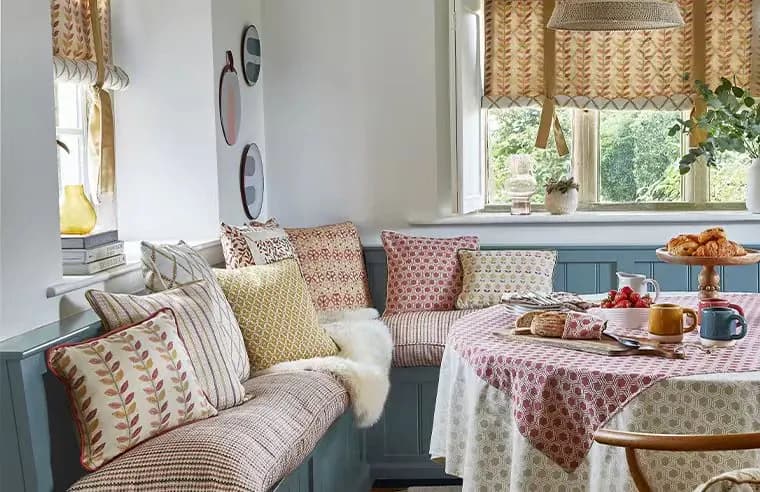
Read the window before borrowing the look.
A ceiling-mounted curtain looks different when there is a deep cornice, little stack-back or a bulkhead that ends short of the glass. A relaxed Roman may be beautiful over a small sash and impractical where a fully opening casement needs the same space as its stack.
Use an inspiration image to describe qualities: soft or crisp, compact or generous, translucent or opaque. Then translate those qualities into a treatment that can be installed and operated at your opening.
Start with the room’s hardest job.
Coordinate; do not force every window to match.
A face fabric can connect a Roman blind at a smaller window with curtains at adjacent doors. The construction will change its appearance: horizontal folds interrupt a pattern and drapery creates vertical shadows. Review both samples as part of one palette.
A roller behind a decorative curtain can separate daily light control from the visible textile. Check the brackets and clearances as a combined installation so the rear treatment is not an awkward afterthought.
Use imagery honestly.
The V1 image collection illustrates materials, layering and room proportions. It is not presented as a catalogue of verified CCBD installations. Individual project stories will be added with approved photographs, an accurate brief and the confirmed specification.