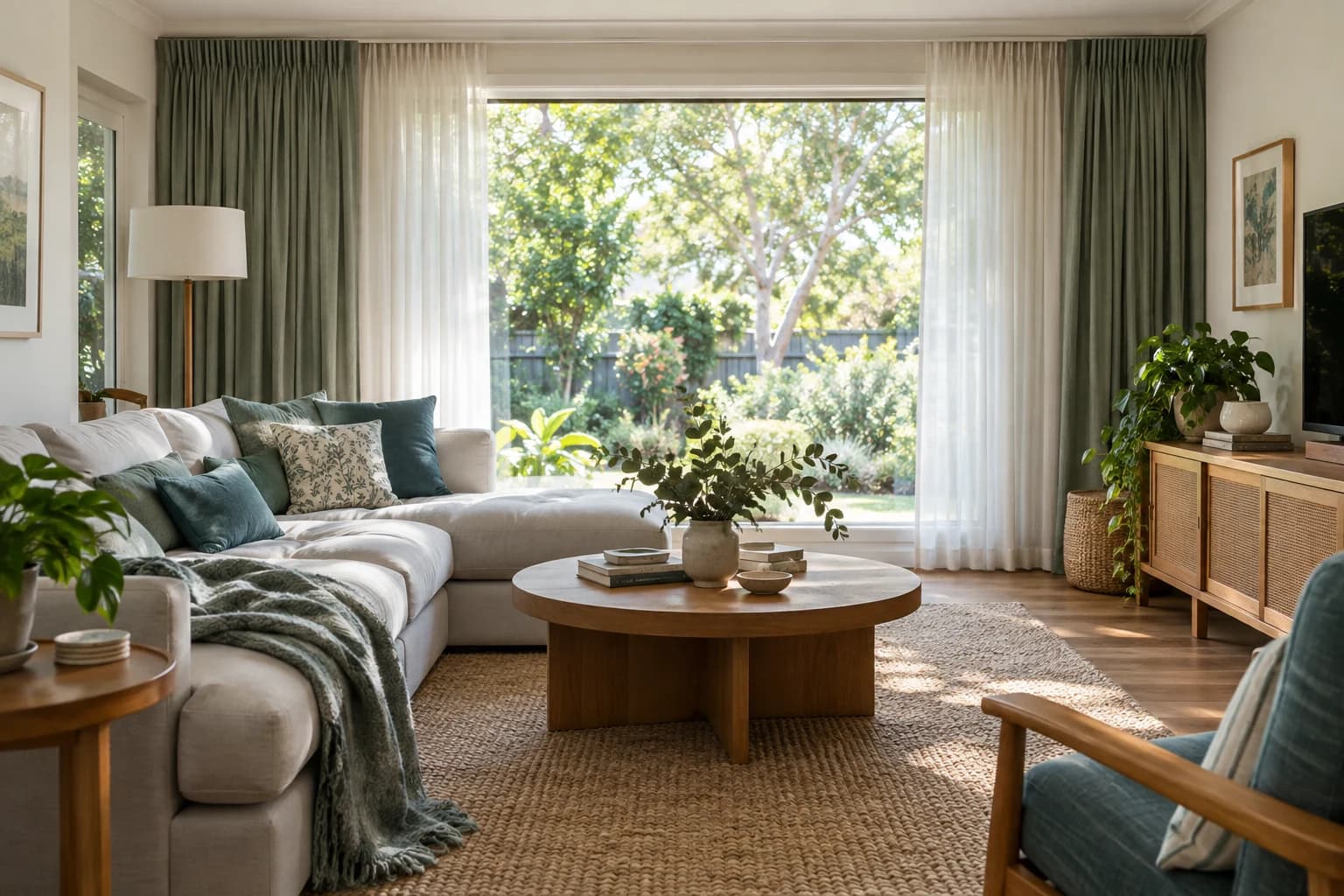
Test the room in two different light conditions
Daytime screening and night-time privacy are separate tasks. A sheer that softens the view from the street during daylight can reveal the interior when lamps are on and outside is dark. Where both matter, plan an independent privacy layer rather than asking a single transparent fabric to do both jobs.
On western glazing, look at the hours when sun reaches the seating, flooring and television. Interior furnishing can manage glare, but fabric should not be presented as a complete answer to solar heat or UV exposure without product evidence. Exterior shading and the glazing itself may also need consideration.
Choose by the space around the opening
| Room condition | Direction to explore |
|---|---|
| Broad glazing with wall space beside it | Curtains with a planned stack-back so the open position preserves the outlook. |
| A smaller window above furniture | A tailored Roman blind, with its raised stack checked against the remaining glass. |
| Frequent access to a balcony or terrace | A curtain draw direction or divided blind arrangement that respects the active door. |
| A minimal room with limited fabric space | Roller blinds for compact operation, with an optional curtain layer for softness. |
- Room condition
- Broad glazing with wall space beside it
- Direction to explore
- Curtains with a planned stack-back so the open position preserves the outlook.
- Room condition
- A smaller window above furniture
- Direction to explore
- A tailored Roman blind, with its raised stack checked against the remaining glass.
- Room condition
- Frequent access to a balcony or terrace
- Direction to explore
- A curtain draw direction or divided blind arrangement that respects the active door.
- Room condition
- A minimal room with limited fabric space
- Direction to explore
- Roller blinds for compact operation, with an optional curtain layer for softness.
Make adjacent windows read as one composition
Align track positions with the architecture, not simply with the top of each individual frame. A continuous ceiling line can be useful, but bulkheads, cornices and unequal wall widths may call for separate treatments. Fullness, return depth and stack width should be resolved on the drawing before the fabric quantity is finalised.
- Check that the curtain clears door handles and stays outside the walking route.
- View larger fabric samples beside upholstery in both daylight and evening lighting.
- For a hollow-sounding open-plan room, discuss the acoustic brief separately from decorative fabric selection.
Before you decide
Questions & answers
Will an S-fold curtain suit a small living room?
It may, if there is enough depth for its regular waves and sufficient room for the stack. A pinch-pleat heading or a Roman blind can be more appropriate where furniture or a narrow return constrains that space.
Should the curtain finish on the floor?
A measured floor-skimming finish often suits a room with regular foot traffic. The final clearance should reflect floor level variation, fabric movement and cleaning; a decorative puddle needs more space and maintenance.