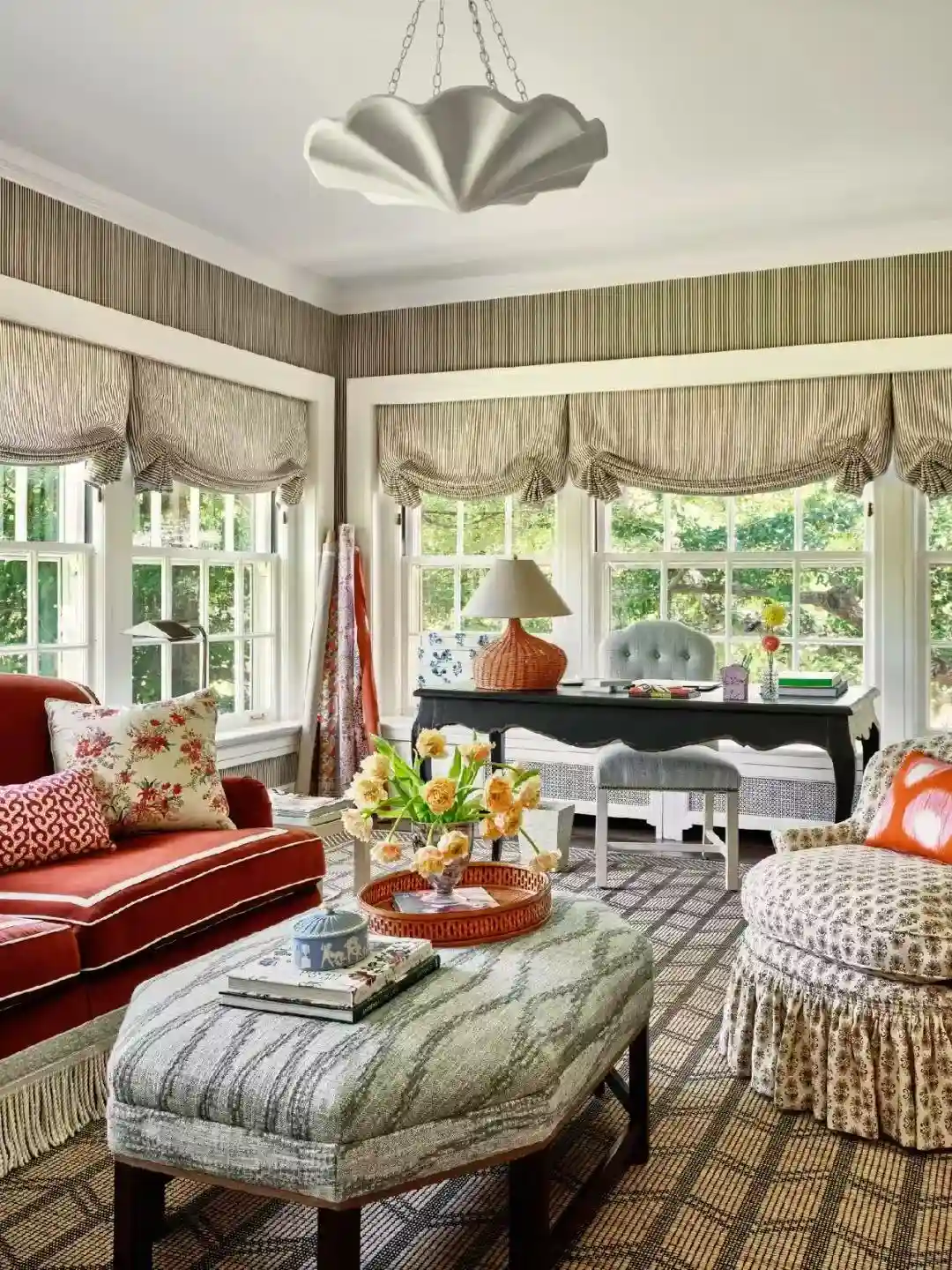
Establish the silhouette before the trim
Begin with the complete wall elevation: window height, ceiling detail, architraves and the width occupied by open curtains. The lowest point of a swag affects the visible glazing, while the tails create vertical weight at the sides. A treatment can feel heavy because of proportion, even when the cloth itself is light.
The arrangement may be symmetrical in a formal room or deliberately adjusted to suit a bay or a constrained wall. Make that decision before choosing braid, fringe or contrast piping; trim should reinforce the form rather than rescue an unresolved outline.
The cloth must make the intended fold
| Decision | What to examine |
|---|---|
| Drapability | A supple cloth forms a different curve from a crisp or heavily backed material. Assess a generous sample in folds. |
| Pattern and pile | Check motif placement and directional appearance across curved and vertical sections. |
| Lining and support | Balance body and a clean reverse against the extra bulk introduced at gathered points. |
| Trim | Consider its weight, scale and how it follows the edge without pulling the fabric out of shape. |
- Decision
- Drapability
- What to examine
- A supple cloth forms a different curve from a crisp or heavily backed material. Assess a generous sample in folds.
- Decision
- Pattern and pile
- What to examine
- Check motif placement and directional appearance across curved and vertical sections.
- Decision
- Lining and support
- What to examine
- Balance body and a clean reverse against the extra bulk introduced at gathered points.
- Decision
- Trim
- What to examine
- Consider its weight, scale and how it follows the edge without pulling the fabric out of shape.
Separate decoration from daily operation
The curtain or blind beneath the decorative treatment still needs a clear path, useful privacy coverage and access for cleaning. Plan the mounting and removal sequence so the installation can be maintained without dismantling unnecessary layers.
Before you decide
Questions & answers
Are swags and tails only for historic interiors?
They are most convincing where the room supports decorative drapery, but that need not mean strict period reproduction. A quieter cloth and restrained detailing can produce a less formal result.
Can this treatment sit above a Roman blind?
Potentially. Allow for the Roman’s raised stack, headrail and operation, then check that the combined treatment leaves an appropriate amount of visible window.