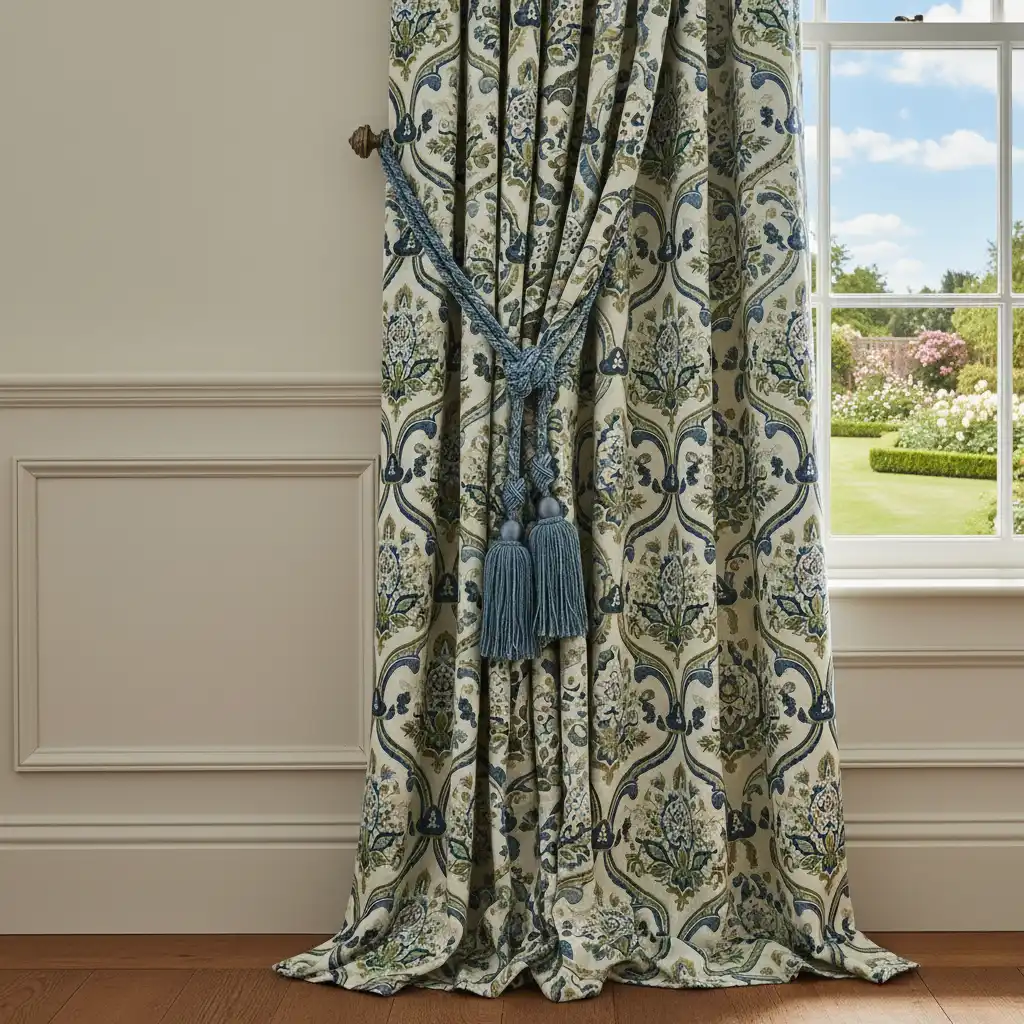
Read the sample in three ways
- Against the light: inspect translucency, weave variation and the difference between a single layer and overlapping folds.
- In the hand: form the proposed heading and allow the cloth to hang. Look for stiffness, body and how readily it settles.
- With its information sheet: check composition, usable width, repeat, directional restrictions, lightfastness information and cleaning instructions.
Specify the complete layered construction
| Layer | Purpose and trade-off |
|---|---|
| Face fabric | Sets the colour, texture and decorative pattern. Its beauty on a flat sample does not establish its suitability for every heading. |
| Privacy or blockout lining | Changes translucency and shields the reverse of the face fabric. Added weight and stiffness can change the finished fall. |
| Interlining, where appropriate | Adds body between layers. It also adds bulk, so fabric compatibility, heading and stack-back need reassessment. |
- Layer
- Face fabric
- Purpose and trade-off
- Sets the colour, texture and decorative pattern. Its beauty on a flat sample does not establish its suitability for every heading.
- Layer
- Privacy or blockout lining
- Purpose and trade-off
- Changes translucency and shields the reverse of the face fabric. Added weight and stiffness can change the finished fall.
- Layer
- Interlining, where appropriate
- Purpose and trade-off
- Adds body between layers. It also adds bulk, so fabric compatibility, heading and stack-back need reassessment.
A pattern is a cutting decision
A large repeat needs a plan for the first visible motif, the relationship between paired curtains and the position of seams. Matching repeats can increase the fabric required; it is not simply a width-times-drop calculation. Directional patterns and pile fabrics also restrict how lengths can be arranged.
For sun-exposed Sydney glazing, choose from the selected fabric’s documented suitability rather than assumptions about natural or synthetic fibres. Review maintenance before ordering: two attractive fabrics with different care requirements may be an awkward layered combination.
Before you decide
Questions & answers
Are natural fibres always the better choice?
Not for every window. The right choice balances handle, appearance, exposure, dimensional behaviour and maintenance. A well-selected blend or performance fabric can be more appropriate for a particular use.
Can a curtain fabric also make a Roman blind?
It needs a separate assessment. A Roman repeatedly lifts, folds and carries its own weight across the width; drape that works beautifully in a curtain may not hold a controlled Roman fold.